
 Julien Paltrinieri


Which tool is the better fit?
Choose Emailx when mail-merged custom fields are no longer producing the reply rates you need and per-contact AI research is the upgrade you want, with email and LinkedIn running from one campaign and warm-up and reply handling included.
Choose Woodpecker when custom-field personalization is already working for you, or when you run an agency with multiple client accounts and need Woodpecker's mature multi-account billing, European data residency, or its now-included LinkedIn outreach. Note Woodpecker added LinkedIn as part of its plans since this page was first written, so channel coverage is no longer the deciding factor between the two products; personalization depth still is.
Feature comparison of Emailx and Woodpecker
The practical differences, before the deeper explanation.
| Outreach tool | Rating | Best for | Starting price |
|---|---|---|---|
| Emailx | ⭐⭐⭐⭐⭐ | Teams that want email and LinkedIn in one campaign with per-contact research, warm-up, and in-app reply handling | 7-day trial (card required), from $29/month |
| Woodpecker | ⭐⭐⭐⭐ | Teams running email and LinkedIn who are fine with mail-merge personalization, agencies managing multiple client accounts, and EU-based teams with data residency requirements | From €35/month (usage-based: ~€7 per 100 contacted prospects) |
How Emailx and Woodpecker approach outbound
A closer look at what each product is designed to help a team do.
Emailx
Overview
 emailx.ai
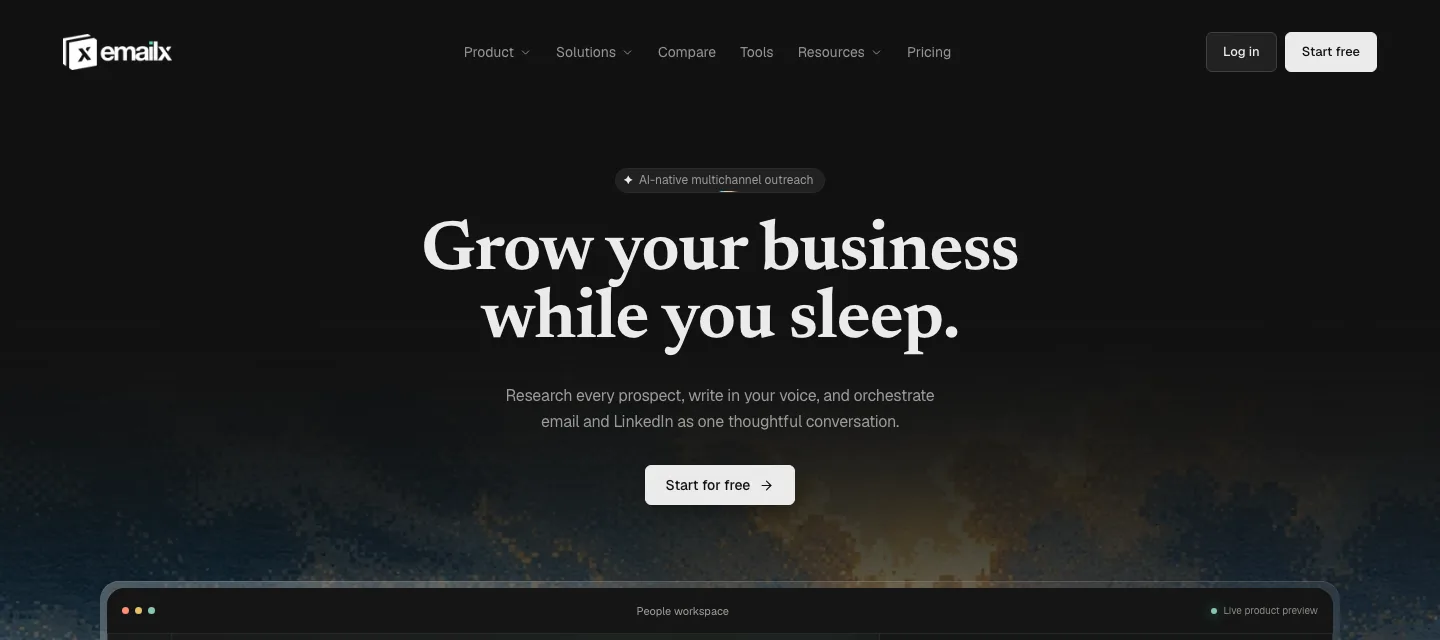
Emailx runs email and LinkedIn from one campaign. Instead of filling a template from custom fields, it researches each contact, reading LinkedIn activity, recent posts, and company signals, then writes to that specific person before the message sends.
LinkedIn sequences run server-side, so no Chrome extension is installed and no browser has to stay open. Warm-up is included from the first plan, and replies are handled inside the tool, with the sequence pausing when a prospect responds on either channel.
Compared with Woodpecker, Emailx's real differentiation is no longer channel coverage, Woodpecker added LinkedIn since this page was first written, but personalization depth: research-grounded writing versus custom fields, plus in-tool reply handling and per-step reporting Woodpecker doesn't provide. It fits teams whose reply rates have plateaued on templates, or who want the AI to do the research rather than just fill a template.
Best features
- Email and LinkedIn from one campaign
- Per-contact research and individually written messages
- Server-side LinkedIn automation, no extension
- Email warm-up included from day one
- In-app reply handling with reply-aware sequences
Pricing
- 7-day trial, card required (up to 250 emails included)
- Plans scale with sending volume, not seats: email from $29/month annual, email + LinkedIn from $83/month annual
- Enterprise: custom, book a consultation
Woodpecker
Overview
 Product overview
Woodpecker is a mature cold outreach platform, founded in Poland in 2015, that has served European B2B sales teams since. It has grown beyond pure email since this page was first written: Woodpecker's own homepage now markets it as a 'Cold Email and LinkedIn outreach tool,' with LinkedIn invites, profile visits, DMs, and InMails available as part of its campaigns, not a separate product.
Its agency mode is a real strength: per-client account separation, white-label options, and multi-account billing make it well established for agencies managing several clients with separate accounts. Its long European presence gives it strong data-residency positioning for teams with EU compliance requirements. Pricing moved from per-mailbox slots to usage-based credits (roughly €7 per 100 contacted prospects, entry plan €35/month), with warm-up, lead-finder credits, and LinkedIn currently bundled at no extra cost within that credit allowance.
Compared with Emailx, personalization is still mail merge rather than per-contact AI research, the only AI-related capability on Woodpecker's site is MCP/API connectivity to external AI tools, not a built-in writer. It fits teams whose reply rates are acceptable with custom fields, particularly agencies that value mature multi-client management.
Best features
- Multi-step email and LinkedIn sequences (LinkedIn added since this page was first checked)
- A/B testing and reply detection
- Custom fields and snippets for mail-merge personalization, not AI-driven per-contact research
- Mature agency mode with per-client separation and white-label
- Usage-based credit pricing, not per-mailbox pricing
Pricing
- Entry plan: ~€35/month, usage-based on ~€7 per 100 contacted prospects
- LinkedIn outreach, warm-up, and lead-finder credits currently bundled within the credit plan
- Agency pricing available with per-client sub-accounts
- Checked 2026-09-07; verify current tiers on Woodpecker's live pricing page before quoting.
Which workflow fits your team?
Start with the work that is difficult today, not the longest feature list.
Choose Emailx if…
Your mail-merge reply rates have plateaued and you want per-contact AI research rather than custom fields.
You want every message researched and written for each contact rather than filled from custom fields.
You want warm-up and in-app reply handling included from day one rather than added or managed elsewhere.
Choose Woodpecker if…
Custom-field mail merge is already producing reply rates you're happy with, and you don't need AI-researched, per-contact writing.
You run an agency with multiple separate client accounts and need mature per-client billing and account separation.
European data residency is a hard compliance requirement for your team.
Where Emailx and Woodpecker meaningfully differ
The decision becomes clearer when you follow the work from research to reply.
AI research behind every message, or fields you fill in yourself
Both products now cover email and LinkedIn, Woodpecker added LinkedIn outreach after this page was first written, so channel coverage isn't the question anymore. The question that remains is what produces the words in the message: research the tool did, or fields the sender filled in.
Woodpecker's personalization runs through custom fields and snippets, a first name, a company name, a sentence the sender researched and typed manually, and its only AI-related capability is MCP/API connectivity to external tools, not a built-in research-and-write step. Emailx reads each contact's LinkedIn activity, recent posts, and company signals before writing, across both email and LinkedIn steps, with the same prospect context and reply state stopping both channels on response. For a team whose mail-merge reply rates have plateaued, this is the difference that matters, not which channels are available.
One shared context across channels, or two coordinated separately
Now that both products run email and LinkedIn, the remaining channel question is not whether LinkedIn exists but how tightly the two channels share context and stop together on a reply.
Emailx runs email and LinkedIn from one campaign context: the same prospect research feeds both channels, and a reply on either one stops the sequence. Woodpecker added LinkedIn invites, profile visits, DMs, and InMails as steps inside its campaigns, which closes the channel gap this comparison used to describe, but exactly how tightly its LinkedIn steps share reply state with email has not been independently re-verified here since the feature was added. Confirm this directly if coordinated cross-channel stopping is a hard requirement.
Replies in your inbox, or in the tool
Where a reply lands decides how a team follows up, especially when more than one person shares lead handling. A reply that arrives only in a personal inbox has no shared view, and coordination depends on people noticing.
In Woodpecker, a reply stops the sequence correctly, but the response arrives in your actual email inbox with no unified reply view or in-app thread. For a solo sender that is fine. For a small team sharing follow-up, two people can answer the same reply, or a follow-up gets missed because it sat in someone's inbox while they were away. Emailx keeps reply handling inside the tool, so the thread and its state are visible to whoever picks it up. If lead follow-up is shared, that shared view removes a common failure point.
Warm-up added late, or built in
Cold email deliverability depends on warming sending infrastructure before the first campaign. Whether warm-up is native or an afterthought affects both startup cost and whether a team has to trust a separate service for reputation.
Emailx includes warm-up in every plan, so a new team does not source or pay for it separately. Woodpecker now includes warm-up too, but it arrived late in the product's history, and reviewers note that teams who needed it earlier had to pay for a third-party tool, with some switching products as a result. For a team starting today the gap has narrowed, since both include it. The distinction mainly matters as evidence of where each product placed deliverability in its priorities, and Emailx treats it as core infrastructure rather than a later addition.
Two usage-based models, one built for multi-client agencies
Woodpecker moved from per-mailbox slot billing to usage-based credits (roughly €7 per 100 contacted prospects, entry plan €35/month) since this page was first written, so both products now scale with usage rather than seats. The remaining pricing difference is not the mechanic, it is Woodpecker's per-client sub-account structure for agencies, which is genuinely mature: separate billing, sending domains, and campaign management per client from one login.
Emailx's plan scales with sending volume across email and LinkedIn, without a comparable multi-client sub-account system. For a pure multi-client agency juggling many separate client relationships, Woodpecker's agency tooling is the more established fit. For a single business running its own outreach, the two products' pricing now behaves similarly, so the deciding factor shifts back to personalization depth and agency structure rather than the billing model itself.
Where each product is not the automatic answer
A good comparison should make the reasons not to switch just as visible.
Where Emailx is not the automatic answer
- Woodpecker's agency mode is more mature, with per-client account separation, white-label options, and multi-account billing built for managing many clients.
- Woodpecker has a longer European track record and stronger data-residency positioning, which matters for teams with strict EU compliance requirements.
- If custom-field mail merge is already producing the reply rates you need, Woodpecker's simple sequence builder may need less onboarding than Emailx's research-first approach.
Where Woodpecker can be the better fit
- Custom-field mail merge is already working for your reply rates and you don't need AI-researched, per-contact writing.
- You run an agency with multiple separate client accounts and need mature per-client billing and white-label options.
- European data residency is a compliance requirement where Woodpecker's positioning is directly relevant.
Which tool should you choose?
Emailx is the stronger fit when the constraint is personalization depth, reply handling, or reporting: per-contact AI research instead of custom fields, writing calibrated to the sender's voice, and reply handling that keeps campaign context visible. Channel coverage is no longer the deciding factor, Woodpecker added LinkedIn outreach since this page was first written, so both products now cover email and LinkedIn. Woodpecker remains the stronger choice for agencies that need mature multi-client account management, per-client billing, or European data residency, where its track record since 2015 is a genuine advantage.
Sources
Verified September 7, 2026. Competitor capabilities and prices change, so each source below records the date it was checked.
- Woodpecker pricingChecked September 7, 2026
- Woodpecker LinkedIn outreach page (added since original check)Checked September 7, 2026
- Woodpecker product overviewChecked September 7, 2026
- Woodpecker reviews on G2Checked August 18, 2026
- Woodpecker reviews on TrustpilotChecked August 18, 2026
- Reddit r/coldemail, Woodpecker discussion threadsChecked August 18, 2026