
 Julien Paltrinieri

Is Emailx the right Salesloft alternative?
Choose Emailx when you are a founder, a startup, or a small sales team that needs AI-personalized email and LinkedIn outreach working this week without a six-figure annual contract, a RevOps function to configure the platform, or a Salesforce instance as a dependency. Salesloft is built for enterprise sales organizations; if that is not your team's profile, the mismatch shows in setup time, pricing, and in which problems the platform's AI actually solves.
Stay with Salesloft when you manage a sales team of twenty or more reps, Salesforce is your system of record, call coaching and pipeline forecasting are central to how your sales organization improves, and you have a RevOps function to configure and maintain an enterprise platform. For that profile, Salesloft is a capable and long-established choice. For every other profile, Emailx addresses the outreach execution layer directly.
Emailx as an alternative to Salesloft
The practical differences, before the deeper explanation.
| Outreach tool | Rating | Best for | Starting price |
|---|---|---|---|
| Emailx | ⭐⭐⭐⭐⭐ | Founders, startups, and small sales teams who need AI-personalized email and LinkedIn outreach without an enterprise contract or RevOps requirement | 7-day trial (card required), from $29/month |
| Salesloft | ⭐⭐⭐⭐ | Enterprise sales organizations with a RevOps function, Salesforce as the system of record, and needs for call coaching, forecasting, and pipeline analytics | Enterprise contract, typically $25,000 to $75,000+ annually, quoted through a sales process |
How Emailx differs from Salesloft
A closer look at what each product is designed to help a team do.
Emailx
Overview
 emailx.ai
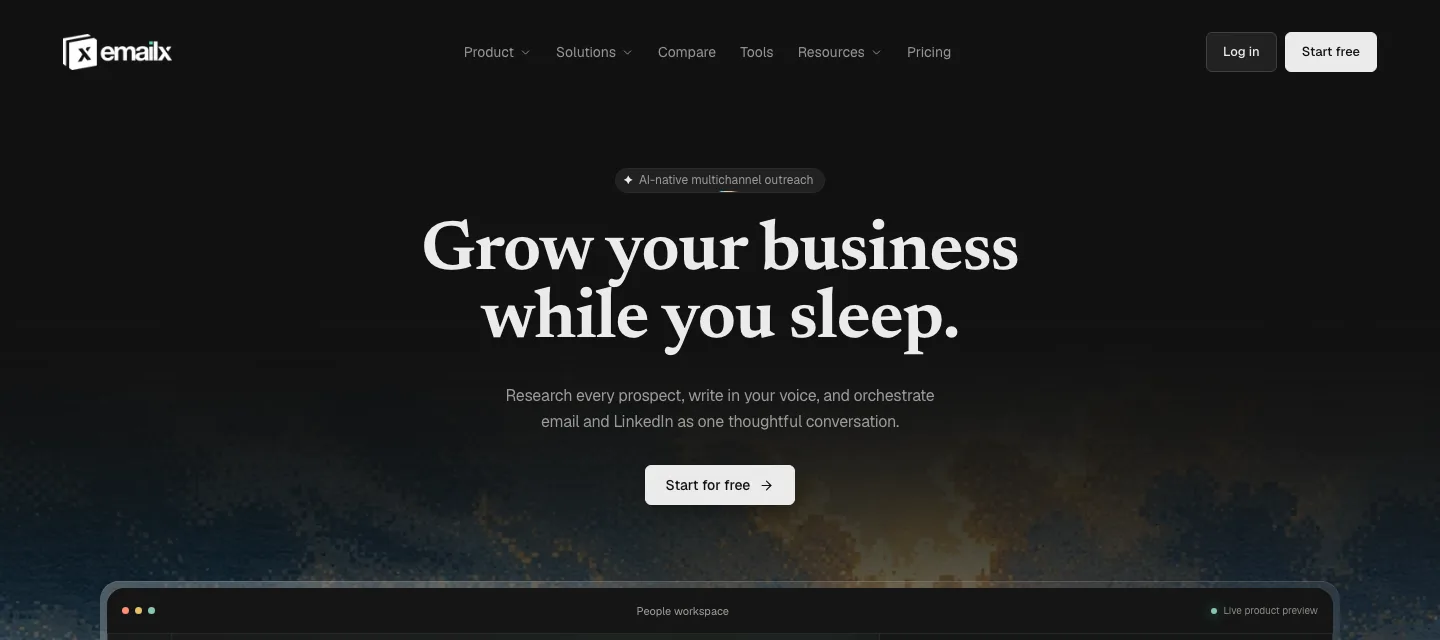
Emailx is a research-led outreach platform for founders and sales teams who want AI-personalized email and LinkedIn running from one campaign without a RevOps team to configure it. You write a context block once per campaign describing who you are reaching and why. Emailx researches each contact, writes a message grounded in something specific to that person, and runs the sequence across email and LinkedIn from there.
The platform is designed to be operational in hours, not weeks. Connecting a mailbox and a LinkedIn account is the setup. There is no Salesforce dependency, no multi-week onboarding, and no minimum seat count. Email infrastructure including domains, mailboxes, and warm-up is included in the plan rather than a separate configuration step.
Emailx AI addresses the outreach execution layer: writing messages that get replies. Salesloft AI addresses the analysis layer: coaching on calls and forecasting pipeline. Those are different problems for different stages of the sales organization, and the comparison matters most to a team that assumed Salesloft's AI would solve the first when it is built for the second.
Best features
- Email and LinkedIn in one campaign with no browser extension required
- Per-contact research that reads LinkedIn profiles and company signals before writing
- Context block per campaign: describe who you reach and why, Emailx personalizes per contact
- Operational in hours without Salesforce, RevOps, or minimum seat count
- Domains, mailboxes, and warm-up included in the plan
Pricing
- 7-day trial, card required (up to 250 emails included)
- Plans scale with sending volume, not seats: email from $29/month annual, email + LinkedIn from $83/month annual
- Enterprise: custom, book a consultation
Salesloft
Overview
 Product overview
Salesloft is an enterprise sales engagement platform founded in 2011. It built its reputation on structured multi-step outreach cadences, call recording and coaching, and deep Salesforce integration, then expanded into pipeline management, deal forecasting, and revenue analytics. In 2023 it acquired Drift to add conversational AI and website chat. Its AI capabilities focus on coaching insights, automated call summaries, and sales signal detection for pipeline management.
Pricing is not publicly listed. Enterprise contracts are typically quoted between $25,000 and $75,000 or more annually depending on seat count and module selection, and require a sales conversation to obtain. G2 reviewers consistently describe Salesloft as the platform a company grows into when it has a dedicated RevOps function, a Salesforce admin, and a sales team large enough to justify the investment.
Salesloft's value is concentrated in the management and coaching layer of a sales organization. It tells sales leaders what happened after reps reached out and helps them improve the team over time. The setup requires the infrastructure to match: Salesforce as the system of record, a RevOps team to configure cadences and field mappings, and a procurement and security review process that enterprise vendors expect.
Best features
- Structured cadences for multi-step multi-channel outreach sequences
- Call recording, AI transcription, and conversation coaching
- Deep bi-directional Salesforce integration with automatic activity logging
- Pipeline management, deal forecasting, and revenue analytics
- AI coaching insights, deal risk signals, and forecasting for sales leaders
Pricing
- No public pricing
- Enterprise contracts typically $25,000 to $75,000+ annually
- Minimum seat commitments and annual contracts through a sales process
- Module pricing for individual platform components
What sends teams looking for an Salesloft alternative
The recurring themes in public reviews of Salesloft, before any Emailx comparison.
Enterprise pricing that excludes the teams who actually searched for it
Salesloft does not publish pricing. Enterprise contracts are typically quoted between $25,000 and $75,000 or more annually and require a multi-week sales conversation to obtain. G2 reviewers from smaller teams and startups consistently describe a pricing discovery process that ends with sticker shock. For a team of three to ten SDRs or a founder running their own outreach, this structure is designed for buyers who are not them.
The minimum contract commitment and the length of the sales cycle alone disqualify Salesloft for most early-stage and growth-stage companies before the product even enters the evaluation. Teams that made it through the demo phase and into pricing negotiations describe the experience of discovering the real cost after investing time in a sales process as a specific frustration. The honest answer for those teams is that Salesloft's pricing is not a limitation to work around: it is the product accurately reflecting who it is built for.
Setup assumes a RevOps function that most small teams do not have
Salesloft requires configuration before it can run. Cadence templates, Salesforce field mappings, CRM sync rules, user permissions, and coaching frameworks all require setup that goes beyond what an individual SDR or founder can complete in an afternoon. G2 reviewers at small companies consistently note that the initial setup takes weeks and that ongoing maintenance requires dedicated RevOps attention.
Teams that lack a RevOps function spend their quota-carrying time in the admin layer instead of running outreach. The platform's complexity is not a defect: it is a feature for organizations large enough to have someone whose job is platform administration. For a team where the SDR and the RevOps function are the same person, Salesloft's onboarding is a cost that arrives before the first message sends.
AI built for coaching, not for writing the first message
Salesloft AI surfaces call coaching insights, deal risk signals, and pipeline forecasting. It analyzes what happened after a rep reached out: what was said on a call, how a deal is trending, which accounts are at risk. It does not read a prospect's LinkedIn profile and write a cold message grounded in something specific to that person.
For teams whose primary problem is getting a reply to the first email, Salesloft's AI addresses a completely different layer of the sales process. Reviewers who expected AI-personalized outreach copy and discovered the AI is focused on post-outreach analysis describe a significant expectation mismatch. The problem is not that Salesloft's AI is weak: it is that it is designed for the coaching and forecasting layer, which only matters once the outreach layer is already working.
LinkedIn requires a separate tool and a manual workflow
Salesloft integrates with LinkedIn Sales Navigator for prospect data import, but it does not run native LinkedIn connection requests, message sequences, or profile activity as part of a cadence. Running coordinated email and LinkedIn outreach from Salesloft requires adding a separate LinkedIn automation tool and managing both in parallel, including two inboxes, two sequence states, and two sets of reply logic.
For teams where LinkedIn is a primary channel alongside email, this adds cost, complexity, and the risk of a prospect receiving a LinkedIn message after they already replied to an email because the two systems do not share a reply state. Salesloft's CRM can record LinkedIn connections as pipeline activity, but recording is not the same as running a coordinated outreach sequence. Teams that want LinkedIn and email to behave as one campaign will need a different product or a significant workaround.
Long ramp time and adoption problems among reps
G2 and Capterra reviewers, particularly managers and sales leaders, consistently note that Salesloft takes longer than expected for reps to adopt and use consistently. The platform's breadth means there are many places to click and configure before a rep's workflow is set up correctly. In fast-moving sales environments, that ramp time translates directly into delayed pipeline.
The adoption problem is worth noting separately from the setup problem because it persists after onboarding. Managers describe regular check-ins where reps are technically set up on Salesloft but not using the sequencing features consistently, defaulting to email and phone outside the platform. The reporting layer that managers buy Salesloft for is only useful when reps log their activity in it, which creates a dependency on adoption that is harder to solve than a technical configuration.
Should your team switch?
Start with the work that is difficult today, not the longest feature list.
Switch to Emailx if…
You are a founder or a small sales team that needs AI-personalized email and LinkedIn outreach working this week without a six-figure contract, a multi-week sales process, or a RevOps team to configure the platform.
You want AI that reads each prospect's LinkedIn profile and writes a message grounded in something specific to them, rather than AI that coaches on calls or flags deal risk.
You need LinkedIn and email outreach from one campaign without a separate LinkedIn automation tool running in parallel.
You do not have Salesforce as your system of record and do not want a platform whose value compounds specifically around Salesforce.
Stay with Salesloft if…
You manage a sales team of twenty or more reps and need pipeline forecasting, rep performance analytics, and call coaching in the same platform as outreach sequences.
Salesforce is your system of record and you need deep bi-directional CRM sync with automatic activity logging as a platform-level requirement.
Call recording, AI transcription, and conversation coaching are central to how your sales team develops and you need that layer built in.
Your organization's IT and security teams need to approve outreach tooling and you need a vendor designed for enterprise procurement and compliance.
What changes when you move from Salesloft to Emailx
The decision becomes clearer when you follow the work from research to reply.
Operational in hours, or in weeks after configuration
The time between deciding to use a tool and sending the first campaign is not just an onboarding metric. It is the cost of the decision itself, measured in quota-carrying days spent in an admin layer instead of running outreach. That cost is small for a large organization with dedicated setup resources and enormous for a founder who needs outreach working this week.
Emailx is designed to be operational in hours: connect a mailbox and LinkedIn account, write a context block, and start. There is no Salesforce field mapping, no cadence template configuration, and no multi-week onboarding. Salesloft takes weeks to configure correctly, and G2 reviewers at small companies consistently describe that ramp time as a significant friction. The difference is not a matter of platform depth: it is a mismatch between what a small team needs and what Salesloft is architected to provide.
AI that writes the first message, or AI that improves what happens after
There are two places AI can help in a sales motion: before the first message sends, and after the first meeting happens. Both are real and both are valuable, but they serve different roles in a sales organization, and the confusion between them is the most common mismatch in this product category.
Emailx AI works before the campaign: it reads each prospect's LinkedIn profile and company signals, then writes a message that references something specific to that person. Salesloft AI works after the call: it transcribes the conversation, surfaces coaching insights, and flags deal risk. For a team whose primary problem is getting a reply to the first email, Salesloft's AI does not address that layer at all. For a team that has the outreach working and needs to improve how reps handle the call, Salesloft's AI is exactly the right tool. The question is which problem you are actually trying to solve.
LinkedIn native in the sequence, or LinkedIn as a separate workflow
A prospect who receives an email and a LinkedIn message in the same campaign is having one outreach experience, even if two products are managing it. When the email gets a reply and the LinkedIn follow-up fires two days later because the two systems did not share a reply state, that prospect's experience of your outreach is defined by the failure to coordinate, not by the quality of either message.
Emailx runs LinkedIn and email from the same campaign with a shared reply state, so a response on either channel stops both. Salesloft integrates with LinkedIn Sales Navigator for data import but does not run native LinkedIn sequences as part of a cadence. Teams that want coordinated email and LinkedIn outreach in Salesloft add a separate LinkedIn automation tool and manage the reply state by hand. That is workable for a large operations team. For a small team running outreach without dedicated ops, it is where the coordination breaks down.
No minimum contract, or an enterprise procurement cycle
The honest question about platform pricing is not which headline number is lower. It is whether a team can start, evaluate, and expand the tool without a procurement cycle that takes longer than the first campaign would have. For a founder or a startup, the answer to that question rules out a category of platforms before any feature comparison begins.
Salesloft requires a sales conversation to receive pricing, and enterprise contracts start at figures that make sense for a large sales organization with a legal and procurement team to manage the process. Emailx does not require a minimum contract, a sales conversation, or a seat minimum. For the segment of teams that drives most Salesloft alternative searches, that structural difference is the deciding factor before any product capability is evaluated.
Salesforce as a requirement, or no CRM dependency
Salesloft's value compounds most when Salesforce is the system of record. The bi-directional sync, automatic activity logging, deal stage updates, and custom field mapping are the features that make Salesloft a complete revenue platform rather than a sequencing tool. Teams using HubSpot, Pipedrive, or no CRM find the integration story less complete and some of the highest-value capabilities either inaccessible or requiring manual effort to replicate.
Emailx does not require a CRM as a dependency. You import contacts by CSV or LinkedIn URL, run campaigns, and manage replies inside the tool. For teams without Salesforce or without a CRM at all, this means the setup has no external dependency to configure. For teams with a strong Salesforce deployment that they intend to keep as the system of record, the CRM integration question is worth asking before the evaluation goes further in either direction.
When switching is not the right move
A good comparison should make the reasons not to switch just as visible.
When Emailx is not the right switch
- You manage a large sales team and need call coaching, AI transcription, and conversation analytics to develop reps over time.
- Pipeline forecasting and revenue analytics at the manager and VP level are requirements the platform must deliver, not just email and LinkedIn outreach.
- Salesforce is your system of record and you need deep bi-directional CRM sync as a platform-level dependency.
- Your organization's IT and legal teams must approve outreach tooling and you need a vendor designed for enterprise security reviews and procurement.
When an Emailx trial is worth running
- You received a Salesloft demo and realized the pricing and complexity are built for a team two or three times your size.
- You need AI that writes outreach messages grounded in per-prospect research, not AI that analyzes calls and flags deal risk.
- You want LinkedIn and email running as one campaign without a separate LinkedIn tool and manual reply-state coordination.
- You are a founder or a two to ten person sales team that needs outreach working this week, not after a multi-week procurement and configuration cycle.
Should you switch from Salesloft?
The clearest signal for switching is finding yourself in a multi-week Salesloft sales and onboarding process before the first campaign message sends. If your team will spend more than a working week on configuration before reaching prospects, that setup cost is worth comparing against a year of Emailx. Salesloft is the stronger choice for enterprise sales organizations that need call coaching, pipeline forecasting, rep performance analytics, and deep CRM integration in one platform and have the infrastructure to support it. The test is a simple one: if your team's primary challenge is writing outreach messages that get replies and running email and LinkedIn from one coordinated campaign, Emailx addresses that directly. If your team's challenge is improving what reps do on calls, forecasting pipeline at scale, and reporting performance to a VP of sales, Salesloft addresses that directly.
Sources
Verified September 7, 2026. Competitor capabilities and prices change, so each source below records the date it was checked.
- Salesloft product pagesChecked September 7, 2026
- Salesloft reviews on G2Checked September 7, 2026
- Reddit r/sales and r/coldemail, Salesloft alternative discussionsChecked August 20, 2026