
 Julien Paltrinieri

Is Emailx the right Lemlist alternative?
Choose Emailx when the per-seat cost of Lemlist's Multichannel plan has started climbing with your team's headcount, when the Chrome extension powering LinkedIn sequences is unreliable, or when you want each message to sound individually written rather than template-filled with AI compose on top. Emailx does not charge per seat and runs LinkedIn server-side with no extension to babysit.
Stay with Lemlist when SMS, WhatsApp, or built-in VoIP calling are part of your sequence, when you rely on its 650 million contact database as a prospect source, or when lemAgent's autonomous campaign creation is saving your team significant time. Emailx does not replace those capabilities, and the page below says so clearly.
Emailx as an alternative to Lemlist
The practical differences, before the deeper explanation.
| Outreach tool | Rating | Best for | Starting price |
|---|---|---|---|
| Emailx | ⭐⭐⭐⭐⭐ | Teams paying per seat for LinkedIn sequences who want per-contact AI research, server-side LinkedIn, and pricing that scales with contacts rather than headcount | 7-day trial (card required), from $29/month |
| Lemlist | ⭐⭐⭐⭐ | Teams that need SMS, WhatsApp, VoIP calling, a built-in lead database, or lemAgent's autonomous campaign creation alongside email and LinkedIn | Email-only: $55/month unlimited users; Multichannel: from $87/user/month |
How Emailx differs from Lemlist
A closer look at what each product is designed to help a team do.
Emailx
Overview
 emailx.ai
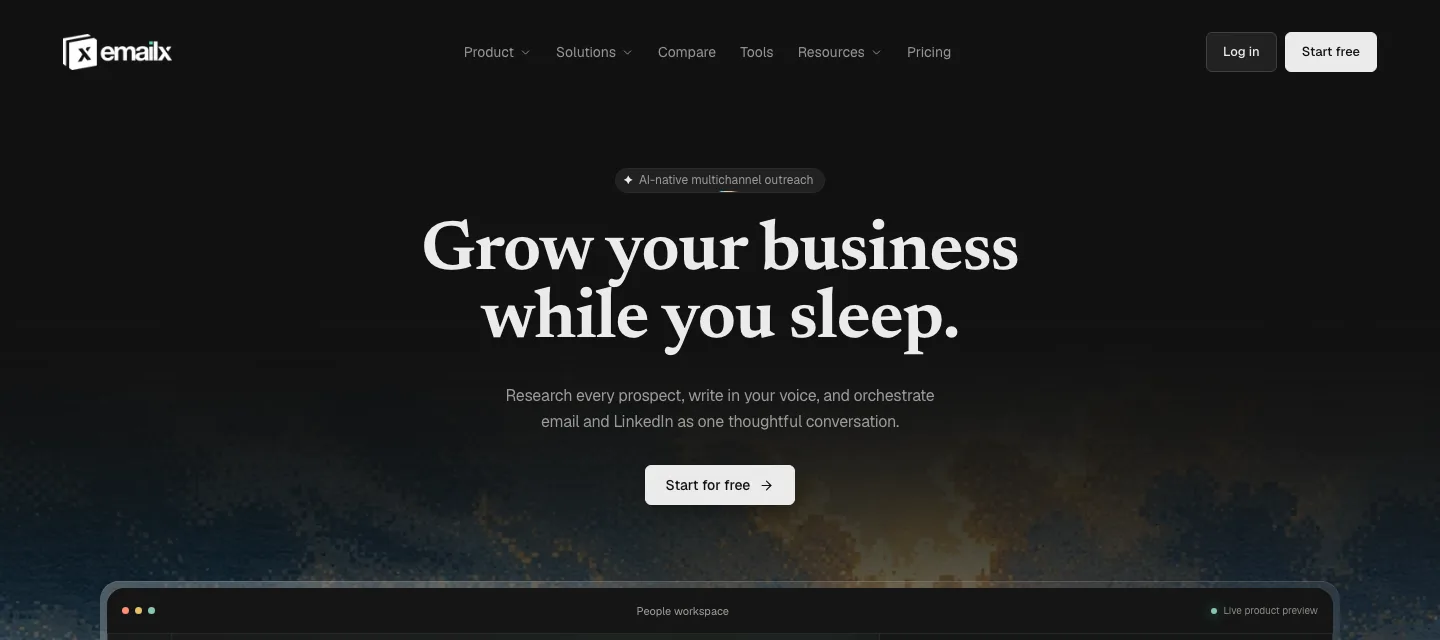
Emailx runs email and LinkedIn from one campaign without per-seat pricing and without a Chrome extension. The pricing model scales with the contacts you actually work: a team of five using the same contact volume as a team of one pays the same structure. LinkedIn runs server-side, so sequences fire whether or not a browser is open, and no extension account is at risk of a detection flag.
Before any message sends, Emailx reads each contact's LinkedIn profile, recent posts, and visible company signals, then writes copy grounded in something specific to that person. This is not merge variables on a sender-written template: it is per-contact live research that produces messages that read as individually composed. The sender's voice is calibrated from their existing sent mail, posts, and tone samples, so the output sounds like the specific sender rather than a general AI assistant.
Email infrastructure is included: domains, mailboxes, and warm-up are part of the plan. There is no separate warm-up tool to configure and no third-party deliverability subscription to maintain alongside the sequencer. For a team whose Lemlist cost or extension reliability has become the operational constraint, Emailx addresses both directly.
Best features
- Email and LinkedIn in one campaign, priced per contact not per seat
- Per-contact research reading LinkedIn profiles before every message
- Server-side LinkedIn, no Chrome extension to install or maintain
- Sender voice calibration from existing sent mail and posts
- Domains, mailboxes, and warm-up bundled in plan
Pricing
- 7-day trial, card required (up to 250 emails included)
- Plans scale with sending volume, not seats: email from $29/month annual, email + LinkedIn from $83/month annual
- Enterprise: custom, book a consultation
Lemlist
Overview
 Product overview
Lemlist is a multichannel outreach platform covering email, LinkedIn, SMS, WhatsApp, and VoIP calls in one sequence builder. It ships with a 650 million contact database, AI enrichment across multiple providers, voice message support via ElevenLabs, and lemAgent, an AI agent that builds lead lists and writes sequences autonomously. It has a large and active user community, an extensive template library, and native integrations with HubSpot, Salesforce, and Pipedrive.
The Multichannel plan, which includes LinkedIn automation, is priced per user at approximately $87 to $109 per month. The Email-only plan is $55 per month for unlimited users and covers email without LinkedIn. LinkedIn automation runs through a Chrome extension that must remain active for sequences to fire. The built-in contact database is broad, and review clusters flag variable data quality in exports, with bounce rates that consume database credits on invalid records.
Lemlist is a genuinely capable platform for teams that need five-channel outreach from one tool. The Chrome extension for LinkedIn and the per-seat Multichannel cost are the most consistently cited operational constraints in public reviews. For teams that need SMS, WhatsApp, calling, a built-in database, or lemAgent's autonomous campaign creation, Lemlist is the more complete tool.
Best features
- Email, LinkedIn, SMS, WhatsApp, and VoIP calls in one sequence builder
- 650 million contact database with AI enrichment across multiple providers
- lemAgent autonomous campaign creation: builds lead list and writes sequence autonomously
- Chrome extension for LinkedIn automation, browser must remain open
- Native HubSpot, Salesforce, and Pipedrive integrations
Pricing
- Email-only: $55/month (annual billing) for unlimited users, $69/month billed monthly
- Multichannel (includes LinkedIn): from $87/user/month annual, $109/month billed monthly
- Checked 2026-09-07; verify current tiers on Lemlist's live pricing page before quoting.
What sends teams looking for an Lemlist alternative
The recurring themes in public reviews of Lemlist, before any Emailx comparison.
The Multichannel plan's per-seat cost climbs with every new team member
Lemlist's Email-only plan is $55 per month for unlimited users, which is good value for email-only outreach. The Multichannel plan, which includes LinkedIn automation, is priced per user at approximately $87 to $109 per month. A five-person team using LinkedIn sequences is at roughly $435 to $545 before any add-ons. A ten-person team clears $870 to $1,090 per month for the same plan.
Reviewers who initially selected Lemlist for its multichannel capability describe the per-seat Multichannel cost as the primary reason to look for an alternative once the team grows past three or four people. The Email-only plan avoids this but excludes the LinkedIn feature most teams came for. For agencies whose headcount varies by client load, the per-seat model makes costs unpredictable in the direction that hurts most: the bill grows when work is growing, which is when the margin is already under pressure.
The Chrome extension for LinkedIn requires a browser running and is fragile
Lemlist's LinkedIn automation runs through a Chrome extension, which means the browser must stay open for sequences to fire and the user's machine must be running. Reviewers consistently report the extension needing reinstall, logging out unexpectedly, and causing sequences to pause or fail silently. Users running long LinkedIn sequences describe checking the extension status as a regular operational task rather than a set-and-forget workflow.
The deeper risk is to the LinkedIn account itself. Extension-based automation sits closer to LinkedIn's detection patterns than server-side cloud automation, and reviewers describe profiles being temporarily restricted after extension behavior triggered a detection flag. For teams running LinkedIn outreach at scale or for agencies where a client's LinkedIn account is at stake, extension-based automation introduces a risk that cloud-based alternatives remove by design.
AI compose outputs generic text that still needs rewriting before sending
A steady theme across G2 reviews is that Lemlist's AI compose and sequence generation produces text that must be rewritten before anyone is comfortable sending it. Reviewers are not describing broken output. They are describing text that is clean, grammatical, and unmistakably generated: the kind of opener that experienced prospects can identify in the first sentence.
The mechanism is a design choice rather than a defect. Personalization works by merging variables and enrichment fields into a template, which produces a message that is technically about the recipient while carrying no evidence that anyone read their work or thought about why they specifically might want to respond. lemAgent builds and writes sequences autonomously, which is genuinely useful for teams that need to launch campaigns fast from a goal description. The output quality for reply rates is a different question, and the reviewers who flag heavy editing time are usually the teams for whom reply rates matter more than campaign launch speed.
The built-in lead database has variable data quality and expiring credits
Lemlist's 650 million contact database is convenient, but reviews frequently flag outdated emails, high bounce rates from database contacts, and credits wasted on invalid records. The database is broad; the quality of any given export varies and there is no strong built-in guard against spending outreach budget on contacts who will bounce.
This is not a failure of database size: it is a reflection of how quickly contact data becomes stale across a database that large. Teams that rely on the Lemlist database as their primary prospect source describe the bounce rate as a persistent cost that reduces the effective value of the credit budget. For teams that bring their own verified lists or use a dedicated enrichment provider with a freshness guarantee, the database is not a constraint. For teams that depend on the built-in database for prospect sourcing, the quality issue is a structural cost to account for.
Deliverability issues arrive without clear in-platform diagnosis
Review clusters describe email landing in spam despite lemwarm, and throttling that cuts send volume significantly below what users planned without clear in-platform explanation. Users who hit deliverability problems describe a gap between the warm-up dashboard's reported status and the actual inbox placement outcome, similar to the pattern reported for other warm-up tools that report a score rather than a placement measurement.
This theme is worth noting for teams scaling cold email, because deliverability failure is a compounding problem: spam placement damages sender reputation, which makes subsequent campaigns harder to deliver, which compresses the window to course-correct. Emailx includes warm-up in the plan and applies it to a smaller set of mailboxes at lower per-mailbox volume, which is a different approach to the same problem. Whether it produces better outcomes for a specific team's sending pattern is something to test.
Should your team switch?
Start with the work that is difficult today, not the longest feature list.
Switch to Emailx if…
You are paying for Lemlist's Multichannel plan and the per-seat cost is climbing as your team grows.
LinkedIn is a core channel and the Chrome extension has been causing campaign instability or requires regular attention to keep running.
You want each message to sound individually written, with copy grounded in something specific the prospect posted or recently did, rather than a template with AI compose on top.
You do not need SMS, WhatsApp, or VoIP calling as part of your outreach sequences.
Stay with Lemlist if…
SMS, WhatsApp, or VoIP calling is a first-class step in your outreach workflow and you need those channels alongside email and LinkedIn.
You rely on Lemlist's 650 million contact database as your primary prospect source and do not have an alternative data provider.
lemAgent's autonomous campaign creation, from goal description through list building and sequence writing, is saving your team significant setup time.
You need native deep HubSpot, Salesforce, or Pipedrive integrations with automatic activity logging as a day-one requirement.
What changes when you move from Lemlist to Emailx
The decision becomes clearer when you follow the work from research to reply.
Cost that scales with seats, or cost that scales with contacts
The per-seat pricing model and the per-contact pricing model produce different cost curves, and the difference becomes significant as team size diverges from contact volume. A small team working a large list pays differently under each model. A large team working a carefully targeted list pays differently under each. The question is which variable actually reflects how a team's outreach scales.
Lemlist's Multichannel plan charges per user, so the bill grows when the team grows regardless of how many contacts are actually worked. Emailx charges based on the contacts actually worked, with no per-seat component for email and LinkedIn. For a founder or a growing team where headcount is increasing, Emailx's structure is easier to forecast. For a team with a stable headcount and a very large contact volume, the per-seat model may actually be lower cost at scale. The specific numbers are worth calculating for each team's operating model.
Extension-based LinkedIn, or server-side sequences that run without a browser
The architecture question for LinkedIn automation is not primarily a UX preference. It is a risk and reliability question. An extension that requires a browser to stay open introduces three operational risks: the browser closes and sequences pause, the user's machine goes offline and campaigns stop, and the extension behavior is closer to LinkedIn's detection patterns than cloud-based simulation.
Lemlist's LinkedIn automation runs through a Chrome extension, which reviewers consistently describe as requiring attention to keep running reliably. Emailx runs LinkedIn sequences server-side: no browser needs to stay open, no extension is installed on the LinkedIn account, and activity stays within LinkedIn's daily limits by design. For a team running LinkedIn outreach at scale, or for an agency where a client's LinkedIn account is the asset at risk, the architectural difference is the right question to ask before selecting a tool.
Template plus variable enrichment, or per-contact research before writing
Variable enrichment and per-contact research produce different outputs, and the difference is visible to the recipients who receive both kinds of messages in their inbox every day. A variable-enriched message contains facts about the recipient. A research-grounded message references something the recipient did, wrote, or changed recently, which is a different kind of specific.
Lemlist's personalization model starts with a sender-written template and fills variables from list data or enrichment. AI compose generates sequence drafts that users describe as needing rewriting before sending. Emailx reads each contact's LinkedIn profile and recent posts before writing, with the evidence kept beside the draft for review. The output reads as individually composed because the research behind it was done per contact. Whether that distinction matters enough to be worth switching is a question of how central reply rate is to the team's current constraint.
Five channels in one platform, or two channels done well
More channels in one platform is only an advantage when a team uses those channels. A platform with five channels where a team uses two is not better than a platform with two channels where the same team uses both well. The question is whether the additional channels justify the per-seat pricing and the Chrome extension tradeoff.
Lemlist covers email, LinkedIn, SMS, WhatsApp, and VoIP calls from one sequence builder, which is genuinely useful for teams that prospect across all five channels. Emailx covers email and LinkedIn. For teams whose outreach is email and LinkedIn, the Lemlist channel breadth is a capability they are paying for but not using, while the per-seat cost and extension reliability are constraints they are managing every month. The calculus changes for any team where SMS, WhatsApp, or calling are real sequence steps rather than theoretical possibilities.
Warm-up included in the plan, or configured as a separate tool
Email deliverability warm-up is a prerequisite for cold outreach at any meaningful scale, and it requires ongoing attention rather than a one-time setup. The question is whether warm-up is a capability included in the outreach platform or a separate tool with a separate subscription and a separate configuration workflow.
Lemwarm, Lemlist's warm-up tool, is bundled with Lemlist plans, which is a genuine strength. The deliverability complaints in Lemlist reviews are not about warm-up being absent: they are about the warm-up score and the inbox placement outcome not always matching, which is a product design question rather than a missing feature. Emailx includes warm-up in the plan, applied to a smaller set of mailboxes at lower per-mailbox volume. Neither approach guarantees inbox placement: both require testing against a specific domain and campaign configuration to understand actual placement rates.
When switching is not the right move
A good comparison should make the reasons not to switch just as visible.
When Emailx is not the right switch
- SMS, WhatsApp, or VoIP calling are first-class steps in your outreach sequences and you need them in the same platform as email and LinkedIn.
- You rely on Lemlist's 650 million contact database to source prospects and do not have a separate enrichment provider or verified list to bring to a new tool.
- lemAgent's autonomous campaign creation is a workflow your team depends on and you want that level of hands-off automation.
- You need deep native HubSpot, Salesforce, or Pipedrive integration with automatic activity logging as a hard requirement on day one.
When an Emailx trial is worth running
- The Multichannel per-seat cost has grown to a point where a credit-based model would be meaningfully lower cost for the contact volume you actually work.
- Your LinkedIn sequences have been pausing or requiring extension management that cuts into the time the tool was supposed to save.
- You are rewriting AI compose output before every send and want to see if per-contact research produces copy you can send without heavy editing.
- Your outreach is email and LinkedIn only and you are not using the SMS, WhatsApp, or calling channels you are paying to access.
Should you switch from Lemlist?
The decision depends on whether the problem is tool cost, tool reliability, or personalization output. If the Multichannel per-seat bill is climbing but the product is working, the switch is a cost calculation. If extension reliability has become a recurring operational problem, the switch is a reliability decision. If reply rates are flat despite strong open rates, the switch is a personalization experiment worth running. Lemlist is the stronger choice for teams that genuinely need five channels from one platform, that source prospects from its built-in database, or that want lemAgent's autonomous campaign creation. The test worth running is a direct comparison: launch an Emailx campaign against the same list as a current Lemlist sequence and measure reply rates over two to three weeks. The difference in personalization approach shows in the numbers before it shows on a feature comparison page.
Sources
Verified September 7, 2026. Competitor capabilities and prices change, so each source below records the date it was checked.
- Lemlist pricingChecked September 7, 2026
- Lemlist reviews on G2Checked August 20, 2026
- Lemlist reviews on TrustpilotChecked August 20, 2026
- Reddit r/coldemail, Lemlist discussionsChecked August 20, 2026