
 Julien Paltrinieri
Is Emailx the right Woodpecker alternative?
Choose Emailx when mail-merged custom fields are no longer producing the reply rates your outreach needs and per-contact AI research is the next step, or when you want replies handled in a shared workspace rather than routed to your inbox, or when campaign-level reporting isn't enough to tell you which step or variant is actually working.
Stay with Woodpecker when your reply rates are acceptable with custom-field personalization, or when you run an agency with multiple client accounts and need Woodpecker's mature multi-account billing and domain management. Note Woodpecker added LinkedIn outreach as part of its plans since this page was first checked, so channel coverage is no longer the reason to switch; the personalization approach still is.
Emailx as an alternative to Woodpecker
The practical differences, before the deeper explanation.
| Outreach tool | Rating | Best for | Starting price |
|---|---|---|---|
| Emailx | ⭐⭐⭐⭐⭐ | Teams that want per-contact AI research behind every message, not custom-field mail merge | 7-day trial (card required), from $29/month |
| Woodpecker | ⭐⭐⭐⭐ | Teams running email and LinkedIn outreach who are fine with mail-merge personalization, agencies managing multiple client accounts, and EU-based teams with GDPR data residency requirements | From €35/month (usage-based: ~7€ per 100 contacted prospects) |
How Emailx differs from Woodpecker
A closer look at what each product is designed to help a team do.
Emailx
Overview
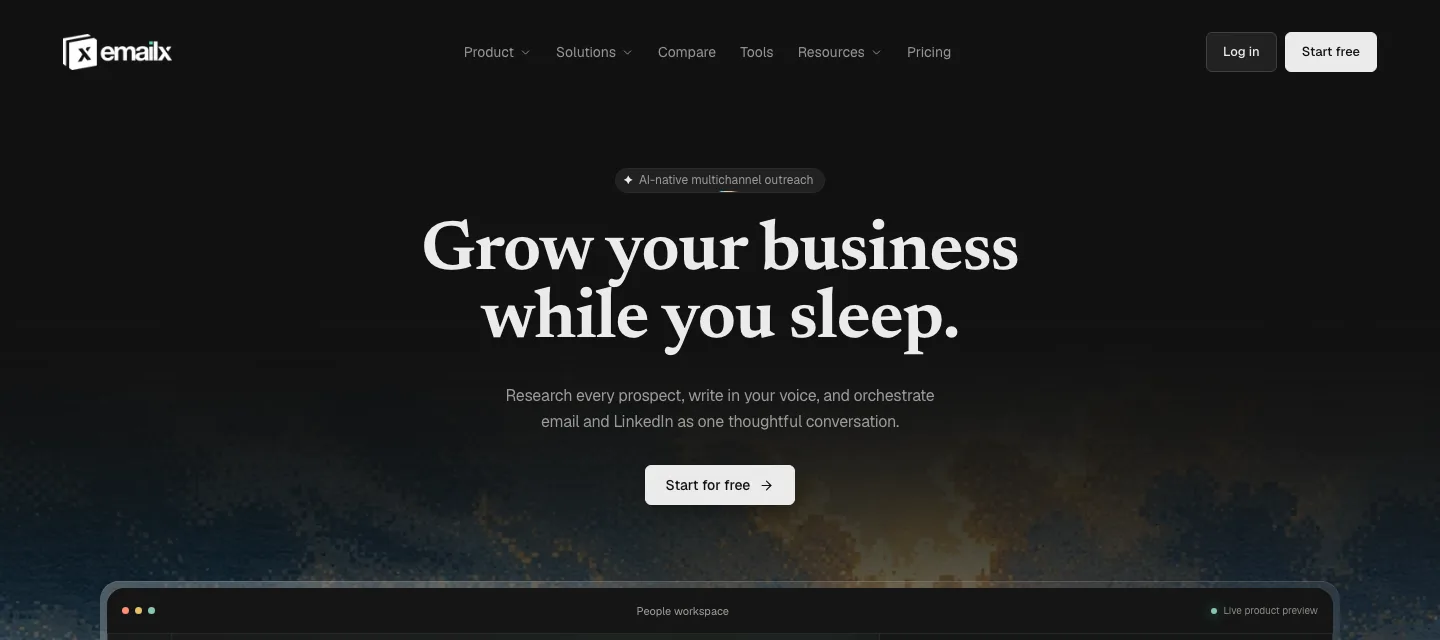 emailx.ai
Emailx is a single product that runs email and autonomous LinkedIn from the same campaign context, with per-contact AI research behind every message rather than fields you fill in yourself.
The workflow puts per-contact research before writing. Emailx reads each contact's LinkedIn activity, recent posts, and company signals, then writes in the sender's voice rather than a general template. LinkedIn steps run server-side, so no browser extension has to stay open, and the sequence pauses on the first reply from either channel.
Compared with Woodpecker, Emailx's real differentiation is no longer channel coverage (Woodpecker added LinkedIn since this page was first checked) but personalization depth: research-grounded writing versus custom fields, plus in-tool reply handling and per-step reporting Woodpecker doesn't provide. It fits founders and small sales teams who want the AI to do the research, not just fill a template.
Best features
- Email and autonomous LinkedIn in one campaign
- Per-contact AI research from LinkedIn activity and company context
- Writing calibrated to the sender's voice
- Server-side LinkedIn, no browser extension required
- Reply-aware sequences that pause on response from either channel
Pricing
- 7-day trial, card required (up to 250 emails included)
- Plans scale with sending volume, not seats: email from $29/month annual, email + LinkedIn from $83/month annual
- Enterprise: custom, book a consultation
Woodpecker
Overview
 Product overview
Woodpecker is a cold email automation platform founded in Poland in 2015. It has become one of the most popular cold email tools in European markets, particularly among SMBs and agencies. It has grown beyond pure email since this page was first written: Woodpecker's own homepage now markets it as a "Cold Email and LinkedIn outreach tool," with LinkedIn invites, profile visits, DMs, and InMails available as part of its campaigns, not a separate product.
Its agency mode is a genuine strength: multiple client accounts with separate billing, sending domains, and campaign management from one login. Personalization still works through custom fields and snippets rather than AI-driven per-contact research; the only AI-related capability on its site is MCP/API connectivity to external AI tools, not a built-in writer. Pricing moved from per-mailbox slots to usage-based credits (~€7 per 100 contacted prospects, entry plan €35/month), with warm-up, lead-finder credits, and the LinkedIn add-on currently bundled at no extra cost within that credit allowance.
Compared with Emailx, Woodpecker now matches on channel coverage but not on personalization depth: its reporting stays at the open, click, and reply level, and replies route to your email inbox rather than a shared in-tool view. For teams whose personalization needs stay at mail-merge level, it remains a reliable, well-supported option.
Best features
- Multi-step email and LinkedIn sequences (LinkedIn added since this page was first checked)
- Reply detection that pauses sequences on response
- Mature agency mode for managing multiple client accounts
- Custom fields and snippets for personalization, not AI-driven per-contact research
- Usage-based credit pricing, not per-mailbox pricing
- Basic A/B testing on subject lines and body copy
Pricing
- Entry plan: ~€35/month, usage-based on ~7€ per 100 contacted prospects
- LinkedIn outreach, warm-ups, and lead-finder credits currently bundled at no extra cost within the credit plan
- Agency pricing available with per-client sub-accounts
- Checked 2026-09-07; verify current tiers on Woodpecker's live pricing page before quoting.
What sends teams looking for an Woodpecker alternative
The recurring themes in public reviews of Woodpecker, before any Emailx comparison.
Personalization is mail merge, not per-contact research
Woodpecker supports custom fields and snippets. That means personalization is inserting a first name, a company name, or a sentence you researched and typed yourself. Checked directly against Woodpecker's site (2026-09-07): the only AI-related capability mentioned is MCP/API connectivity to external AI tools, not a built-in research-and-write step. It is a template with variables, not a research step.
As AI personalization has become mainstream and cold email reply rates have declined across the category, users who came to Woodpecker for its simplicity are now looking for something that does the research and writing work for them. Reviews that describe Woodpecker as 'missing AI' or 'behind on features' are almost always about this gap, one of the two reasons this brief originally cited that's still accurate. (The other, no LinkedIn support, is not: Woodpecker added it since.)
Replies land in your email inbox, not in the tool
When a contact replies to a Woodpecker sequence, the sequence stops correctly, but the reply appears in your actual email inbox. There is no unified reply view inside Woodpecker, no in-app conversation thread, and no way for a team to see and manage replies together in one place.
For a solo user this is tolerable. For a small sales team sharing outreach follow-up, it creates coordination gaps: two people can respond to the same reply, or a follow-up gets missed because it landed in someone's Gmail while they were out. The absence of a unified inbox is not a missing feature on a cheap tool; it is a meaningful limitation for any team with more than one person managing replies.
Reporting stays at the campaign level
Woodpecker shows open rates, click rates, reply rates, and bounce rates per campaign. It does not provide per-contact engagement views, time-to-reply analysis, inbox placement breakdowns, or a way to identify which specific email or subject line variant is driving replies without manual export.
Teams who have scaled to multiple simultaneous campaigns find that Woodpecker's analytics make optimization a guesswork exercise rather than a data-driven one. It is a frequent theme in reviews from users who have grown past the basic use case Woodpecker was built for.
Per-slot pricing grows in unpredictable ways at agency scale
Woodpecker's agency pricing is per slot, meaning per email address, and managing a large number of client mailboxes across multiple campaigns can produce a bill that is harder to predict than it first appears. Agency users in reviews describe having to carefully count slots to avoid unexpected charges, and the per-slot model makes monthly cost estimates tricky when client mailbox counts change.
For a solo user or a small fixed team this is rarely a problem. For an agency adding and removing client mailboxes across billing periods, the slot model introduces a planning layer that some agencies find acceptable and others find genuinely frustrating.
Should your team switch?
Start with the work that is difficult today, not the longest feature list.
Switch to Emailx if…
Your cold email reply rates have plateaued and you want per-contact AI research rather than custom fields and mail merge.
You want replies handled in a shared, in-tool view rather than routed to your email inbox.
You've grown past campaign-level metrics and need to trace a reply back to the specific step or variant that produced it.
You are a founder or small sales team running outreach for your own business rather than managing multiple agency client accounts.
Stay with Woodpecker if…
You run an agency with multiple client accounts, separate billing, and separate sending domains, and Woodpecker's agency mode fits that operating model.
Custom-field mail merge is producing acceptable reply rates and you don't need AI-researched, per-contact writing.
EU data residency is a firm requirement. Woodpecker is built and hosted with European compliance in mind, and Emailx's hosting should be confirmed with the founder before recommending a switch for EU-specific requirements.
What changes when you move from Woodpecker to Emailx
The decision becomes clearer when you follow the work from research to reply.
AI research behind every message, or fields you fill in yourself
Both products now cover email and LinkedIn: Woodpecker added LinkedIn outreach after this page was first written, so channel coverage isn't the question anymore. The question that remains is what produces the words in the message: research the tool did, or fields the sender filled in.
Emailx reads each contact's LinkedIn activity, recent posts, and company signals before writing, across both email and LinkedIn steps, with the same prospect context and reply state stopping both channels on response. Woodpecker's personalization runs through custom fields and snippets (a first name, a company name, a sentence the sender researched and typed manually) and its only AI capability is MCP/API connectivity to external tools, not a built-in research-and-write step. For a team whose mail-merge reply rates have plateaued, this is the difference that matters, not which channels are available.
In-tool reply context, or replies routed to the email inbox
Where a reply surfaces determines how easy it is to respond with context. A reply that arrives in Gmail sits beside marketing emails and newsletters, with no visible thread of what the sequence sent, no record of which step triggered the response, and no shared view for a team.
Emailx routes replies with the campaign context visible so the person responding can see the research and sequence that produced the conversation. Woodpecker routes replies to the email inbox, stops the sequence correctly, and leaves the follow-up to happen in Gmail or Outlook. For a solo operator this is a workflow preference. For a team sharing outreach follow-up, it is a coordination gap that can result in duplicate or missed responses.
Campaign-level metrics, or something you can actually optimize from
Reporting depth becomes a bottleneck at a specific point: when you have run enough campaigns that the question is no longer whether outreach is working, but which part is working and why. Below that threshold, standard metrics are enough. Above it, you need to isolate which step in a sequence, which subject line variant, or which timing pattern is producing replies, and campaign-level totals cannot answer that.
Woodpecker gives you open, click, reply, and bounce rates per campaign. For a solo operator running one or two steady campaigns, that is enough. For a team running multiple campaigns simultaneously who want to trace a reply back to the specific step or variant that produced it, Woodpecker's reporting requires a manual CSV export and spreadsheet analysis to go any further. If reporting depth is the primary driver for considering a switch, confirm Emailx's current reporting capabilities directly before moving.
Agency tooling, or a simpler product for a single business
Woodpecker's agency mode is genuinely purpose-built: separate client accounts, separate billing, separate sending domains, and multiple campaigns managed from one login. For an agency with five or more clients running independent outreach, that architecture fits the job in a way that a product designed for a single business does not.
Emailx is built around a single business running its own outreach, not an agency managing client campaigns. If the agency use case is the reason you chose Woodpecker, that is also the strongest reason to stay. Emailx offers deeper per-contact AI personalization but does not currently match Woodpecker's agency account management depth, and the founder should confirm the current state before claiming parity.
When switching is not the right move
A good comparison should make the reasons not to switch just as visible.
When Emailx is not the right switch
- You run an agency managing multiple client accounts with separate billing and separate sending domains. Woodpecker's agency mode is mature and purpose-built for that operating model.
- Custom-field mail merge is producing reply rates you're satisfied with. Woodpecker is not broken for you.
- EU data residency is a firm compliance requirement. Confirm Emailx's hosting situation with the founder before recommending this switch to EU-based teams.
- Budget is the primary constraint and you are running a single mailbox at very low volume. Woodpecker's entry price may be lower at that scale.
When an Emailx trial is worth running
- Cold email reply rates have plateaued and you have tried more and more custom fields without moving the number.
- Your team is missing replies or sending duplicates because follow-up happens in Gmail rather than in a shared workspace.
- Campaign-level metrics aren't enough anymore and you need to trace a reply back to the specific step or variant that produced it.
Should you switch from Woodpecker?
Emailx is the stronger Woodpecker alternative when the constraint is personalization depth, reply handling, or reporting: per-contact AI research instead of custom fields, writing calibrated to the sender's voice, and reply handling that keeps the campaign context visible. Channel coverage is no longer the deciding factor: Woodpecker added LinkedIn outreach since this page was first written, so both products now cover email and LinkedIn. Woodpecker remains the better system for agencies managing multiple client accounts with separate billing requirements, for EU-hosted compliance requirements, and for teams whose mail-merge personalization is already working. Test Emailx on one campaign where research-led personalization is the missing piece, and keep Woodpecker running for the workflows it already handles well.
Sources
Verified September 7, 2026. Competitor capabilities and prices change, so each source below records the date it was checked.
- Woodpecker pricingChecked September 7, 2026
- Woodpecker LinkedIn outreach page (added since original check)Checked September 7, 2026
- Woodpecker reviews on G2Checked August 19, 2026
- Woodpecker reviews on TrustpilotChecked August 19, 2026
- Reddit r/coldemail, Woodpecker alternative discussionsChecked August 19, 2026