
 Julien Paltrinieri

Is Emailx the right Instantly alternative?
Choose Emailx when the reason you are leaving Instantly is not email volume itself, but the work around it: researching each prospect, writing in a voice that sounds like yours, carrying that context into LinkedIn, and reviewing the reasoning behind every message before it sends.
Stay with Instantly when high email throughput across many sending accounts is the operating advantage your team depends on, or when its lead database is how you source prospects. Changing tools will not improve a workflow that already fits that job.
Emailx as an alternative to Instantly
The practical differences, before the deeper explanation.
| Outreach tool | Rating | Best for | Starting price |
|---|---|---|---|
| Emailx | ⭐⭐⭐⭐⭐ | Teams that want research-led email and LinkedIn outreach with reviewable context | 7-day trial (card required), from $29/month |
| Instantly | ⭐⭐⭐⭐ | Teams running high-volume cold email across many sending accounts | Email Outreach from $47/month |
How Emailx differs from Instantly
A closer look at what each product is designed to help a team do.
Emailx
Overview
 emailx.ai
Emailx is built around the work that happens before a sequence starts. It researches the company, the person, and the timely signals that make an approach relevant, then keeps that evidence beside the draft for review.
It writes in the sender's voice rather than a general assistant register, calibrating from sent mail, posts, and tone samples. Email and LinkedIn use the same prospect context, the sequence stops when someone replies, and a reviewer can inspect or edit a message before it sends.
Domains, mailboxes, and warm-up sit inside the plan rather than beside it. Warm-up is not unlimited, and that is deliberate: fewer mailboxes, prepared more carefully, sending at lower per-mailbox volume.
Best features
- Evidence-led prospect research
- Writing calibrated to the sender's voice
- Email and LinkedIn in one campaign context
- Human review before sending
- Domains, mailboxes, and warm-up included in the plan
Pricing
- 7-day trial, card required (up to 250 emails included)
- Credit-based, scaling with the contacts you actually work rather than a per-seat plan
- Sending infrastructure and warm-up included rather than sold as add-ons
Instantly
Overview
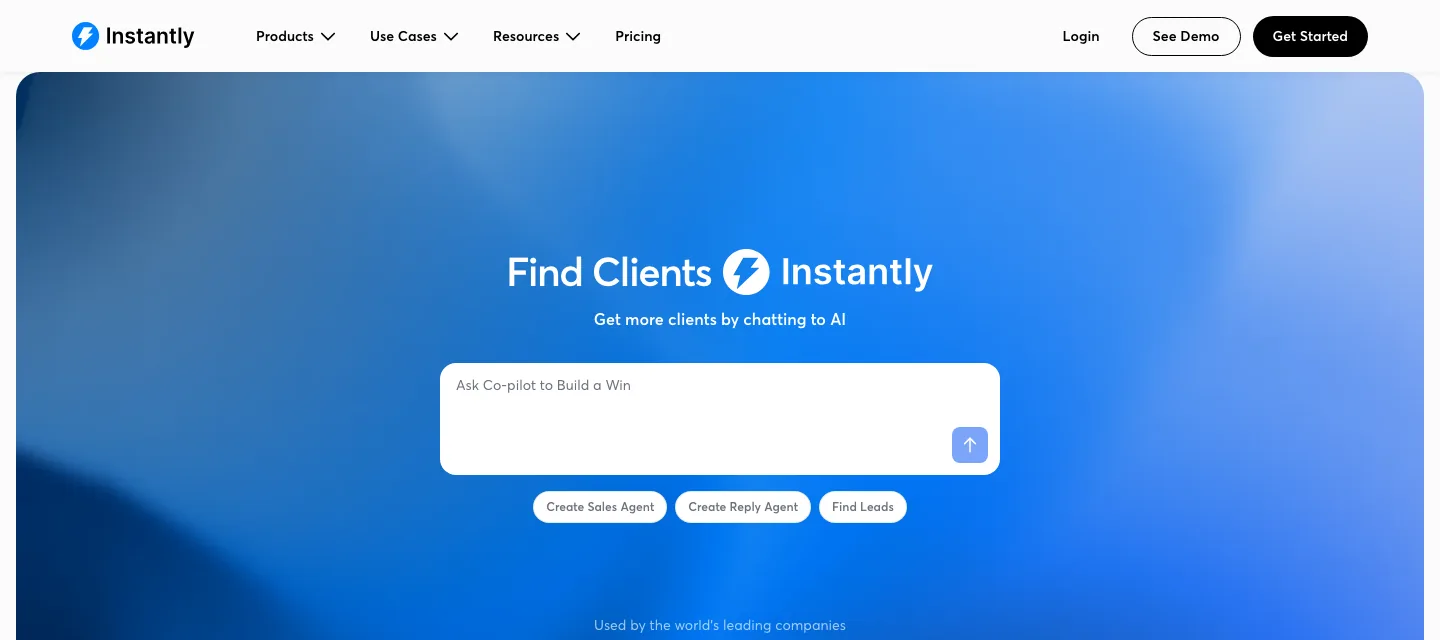 Instantly
Instantly is an email-first sales platform designed to run cold email across many sending accounts. Paid Email Outreach plans include unlimited connected email accounts and unlimited warm-up, with contact and monthly email limits increasing by tier.
Its wider suite is sold across separate pricing tracks. Instantly Credits (leads, enrichment, a web researcher, and AI writing tools) now starts at $47/month, up from an earlier $9/month entry tier. A CRM (master inbox, calls, SMS, campaign automation) exists as a product, but as of this check it no longer appears as its own separately priced tier on the pricing page the way it did before; checked 2026-09-07, worth confirming current packaging before quoting a total. Domains and mailboxes are priced separately again.
That structure is genuinely useful when a team wants to choose its sending, data, and pipeline layers independently. It is also why the honest cost comparison depends on which parts of the suite a team actually buys.
Best features
- Unlimited email accounts on paid Outreach plans
- Unlimited email warm-up on paid Outreach plans
- 450 million lead database through Credits
- AI web research and email writing through Credits
- Separate CRM for communication and pipeline work
Pricing
- Email Outreach Growth: $47/month
- Instantly Credits (leads, enrichment, AI research/writing): from $47/month, up from an earlier $9/month entry tier
- CRM: no longer a separately priced tier as of this check, appears bundled rather than sold standalone; verify current structure before quoting
- Domains and email accounts are priced separately
- Checked 2026-09-07; verify current tiers on Instantly's live pricing page before quoting.
What sends teams looking for an Instantly alternative
The recurring themes in public reviews of Instantly, before any Emailx comparison.
The warm-up score and the inbox are different numbers
The warm-up dashboard is the instrument most teams use to decide a mailbox is ready to send. The recurring complaint on Trustpilot and r/coldemail is that the number and the outcome do not agree: heat scores in the high eighties or above, alongside measured inbox placement that reviewers put closer to a third of sends.
The shape of these reports is consistent. Several weeks in warm-up, a strong score, a launch, then flat replies and climbing spam complaints, with no diagnostic in the product explaining which part failed. Some threads also describe shared warm-up pools losing reputation and taking newly added domains down with them. Instantly's documentation does describe unlimited warm-up on paid Outreach plans, and that is accurate as a capability. The complaint is narrower and worth stating precisely: a heat score is not a placement measurement, and the product does not make that distinction visible before a team commits a campaign to it.
The headline price is the sending layer only
Instantly publishes Email Outreach from $47 per month, and that figure covers sending. The lead database and AI research/writing tools sit in a separate Credits subscription, which now starts at $47 per month, up from an earlier $9 entry tier, checked 2026-09-07. Domains and mailboxes are purchased on top.
Add the entry tiers of Outreach and Credits and a team wanting sourcing plus sending is at roughly $94 per month before a single domain, against a headline of $47, and that gap has widened since Credits' entry price roughly quintupled. To be fair to Instantly, this is not concealed pricing, and a team that only wants sending genuinely pays the advertised number. The frustration is concentrated among buyers who reasonably assumed that finding prospects was part of an outreach platform rather than a second subscription, and that assumption now costs more to correct than it used to.
AI drafts that still need rewriting
A steady theme across G2 reviews is that the AI sequence output has to be rewritten before anyone is comfortable sending it. Reviewers are not describing broken output. They are describing text that is clean, grammatical, and unmistakably generated.
The mechanism they describe is worth understanding, because it is a design choice rather than a defect. Personalization works by merging variables and enrichment fields into a template, which produces a message that is technically about the recipient while carrying no evidence that anyone looked at them. Experienced prospects read that instantly. Several reviewers note the editing time cancels out the drafting time the tool saved. Instantly has since added a Web Researcher Agent and an AI Email Writer through Credits, which changes how much context the tools can gather, but reviewers still describe voice as the part that is not solved.
One channel, natively
Instantly is email-first by design rather than by oversight, and for a large number of teams that focus is exactly the appeal. For teams whose prospects answer faster on LinkedIn than in an inbox, it is the structural reason to look elsewhere.
The CRM can record LinkedIn connections alongside email, calls, SMS, and tasks, and it is worth being precise about what that means: recording a connection is not running a sequence. Teams in this position describe operating a second product for LinkedIn, watching a second inbox, and reconciling by hand who replied where. The failure they report is not missing automation but crossed wires, where a prospect receives a LinkedIn message days after already answering the email.
Expiring credits, and what stays behind
Lead credits do not roll over, so anything unused is lost at the end of the billing period. Reviewers also report database accuracy around 85 percent, which means a share of every export bounces, and bounced records consume the credits that were spent finding them. Separately, teams who used the done-for-you domain provisioning describe friction on the way out, with domains effectively bound to Instantly infrastructure.
One of these Emailx does not fix. Emailx has no lead database at all, so the answer to expiring credits and variable contact data is not a better database, it is that you bring contacts you already have from a CSV, your CRM, or a data provider. If built-in prospect sourcing is a real part of why you bought Instantly, that is a legitimate reason to stay, and nothing further down this page changes it.
Should your team switch?
Start with the work that is difficult today, not the longest feature list.
Switch to Emailx if…
Your list is already defined, but the research and message judgment before each send are still manual.
Email and LinkedIn need to behave as one conversation rather than two separate campaign systems.
A reviewer should be able to see the evidence behind a draft, and the draft should already sound like the sender.
Stay with Instantly if…
Your advantage comes from high-volume cold email across many connected sending accounts.
Managing a large fleet of mailboxes matters more to you than a shared email and LinkedIn workflow.
You actively use Instantly's lead database, CRM, or agency operations and do not want to rebuild that system.
What changes when you move from Instantly to Emailx
The decision becomes clearer when you follow the work from research to reply.
Where research sits, and whose voice writes
A cold message earns a reply when it shows the sender actually looked at the recipient, and when it sounds like a person that recipient could imagine meeting. Those are two separate problems, and most outreach tools solve only the first.
Emailx gathers per-prospect evidence before the campaign exists and keeps it attached to the draft, then calibrates the writing to how the sender already writes, using their sent mail, posts, and tone samples. Instantly offers a Web Researcher Agent and an AI Email Writer through its separate Credits product, which gather context capably and write in a general assistant register. If the constraint is having nothing specific to say, either product will help. If the constraint is that the output does not sound like you, voice calibration is the difference, and it is why Emailx keeps a review step where the evidence and the draft sit side by side.
Channels that share context
Adding a second channel only helps when the next action knows what has already happened. Otherwise multichannel outreach is two sequences pointed at one person, who now has two disconnected reasons to ignore you.
Emailx runs LinkedIn server-side against the same prospect context and reply state as the email sequence, so a reply on either channel stops both, and a LinkedIn message can build on the research the email used rather than restarting the pitch. Instantly's Outreach plans are built around email, with its CRM recording LinkedIn connections as pipeline activity. The gap is decisive for teams whose prospects answer faster on LinkedIn, and close to irrelevant for a motion that is email-only by choice rather than by constraint.
Two ways to protect deliverability
There are two coherent strategies for keeping a sending operation alive. Spread the risk across more mailboxes so no single domain matters, or reduce the risk carried by each mailbox so fewer are needed. They produce different products.
Instantly optimizes the first. Unlimited connected accounts and unlimited warm-up on paid Outreach plans let a team absorb the loss of any individual domain, which is the right design for an agency operating fifty or two hundred inboxes. Emailx optimizes the second. Warm-up is included rather than unlimited, applied to a smaller set of mailboxes prepared more deliberately and sending at lower per-mailbox volume. Neither is universally correct. Fleet economics favour Instantly. Placement on the mailboxes you actually intend to keep favours Emailx.
Which line on the invoice grows
The more useful question is not which product has the lower entry price. It is which part of the bill moves when the team starts to succeed, because that is the number you will live with.
Instantly's bill grows by module. Sending stays flat as you add accounts, which is a real advantage, and cost rises when you add data, pipeline, deliverability tooling, or domains. Emailx bills by the contacts you actually work, with domains, mailboxes, and warm-up inside the plan rather than beside it. A team scaling raw volume across many inboxes will find Instantly's curve flatter. A team scaling quality against a defined list will find Emailx's flatter, because the pieces Instantly prices separately are already in the plan.
What migration changes
Moving outreach tools does not mean every part of the current system should move at once. A bounded first campaign gives a cleaner comparison and keeps a working sending operation available while the new workflow is evaluated.
Contacts move into Emailx through CSV or an existing data source, but campaign logic and messages should be rebuilt around the research workflow rather than copied across. Start with one audience where LinkedIn context or deeper research matters, review the first batch by hand, and compare the preparation effort and the quality of the conversations that follow. Keep Instantly running for high-volume email until Emailx has proved the specific part of the motion it is meant to replace.
When switching is not the right move
A good comparison should make the reasons not to switch just as visible.
When Emailx is not the right switch
- Your team needs high-volume email infrastructure across many sending accounts, where unlimited mailboxes are the point.
- Instantly's lead database is how you source prospects. Emailx has no database and will not replace it.
- LinkedIn is outside your outreach motion, and deeper per-prospect research would not change how campaigns are run.
- You use the Instantly CRM as your pipeline system of record and do not want to move it.
When an Emailx trial is worth running
- The list is good, but the reasons to contact each person now are still assembled by hand.
- Email and LinkedIn are managed separately, and prospects receive duplicated or crossed follow-ups.
- AI drafts get rewritten before they send, and the rewriting is mostly about how they sound.
- Warm-up scores look healthy while replies do not, and you would rather run fewer, better-prepared mailboxes.
Should you switch from Instantly?
Emailx is the stronger Instantly alternative when the constraint is the quality of each conversation rather than the quantity of sends: per-prospect research kept visible beside the draft, writing calibrated to your own voice, coordinated LinkedIn, and warm-up focused on placement across fewer mailboxes rather than unlimited accounts. Instantly remains the better system for teams whose advantage genuinely is fleet scale, and for anyone relying on its lead database, which Emailx does not replace. Test Emailx on one campaign where research, voice, or channel context is the current bottleneck, and keep the existing sending operation running while you compare.
Sources
Verified September 7, 2026. Competitor capabilities and prices change, so each source below records the date it was checked.
- Instantly Plans OverviewChecked August 17, 2026
- Instantly pricingChecked September 7, 2026
- Instantly Email Outreach Plans ComparisonChecked August 17, 2026
- Instantly reviews on G2Checked August 17, 2026
- Instantly reviews on TrustpilotChecked August 17, 2026