
 Julien Paltrinieri

Which tool is the better fit?
Choose Emailx when you want every message researched and written for that specific contact, with email and LinkedIn running autonomously from one workflow without a Chrome extension or a warm-up tool bolted on.
Choose Reply.io when your team needs calling, SMS, and WhatsApp in the same sequence builder, when deep two-way CRM sync with Salesforce or HubSpot is a day-one requirement, or when branch-logic sequence control is the deciding factor.
Feature comparison of Emailx and Reply.io
The practical differences, before the deeper explanation.
| Outreach tool | Rating | Best for | Starting price |
|---|---|---|---|
| Emailx | ⭐⭐⭐⭐⭐ | Teams that want research-led, multichannel outreach with bundled infrastructure and no Chrome extension | 7-day trial (card required), from $29/month |
| Reply.io | ⭐⭐⭐⭐ | Revenue teams that need calling, SMS, WhatsApp, and deep CRM integrations alongside email and LinkedIn in one platform | From $49/user/month (email only); LinkedIn is a $69/mo add-on |
How Emailx and Reply.io approach outbound
A closer look at what each product is designed to help a team do.
Emailx
Overview
 emailx.ai
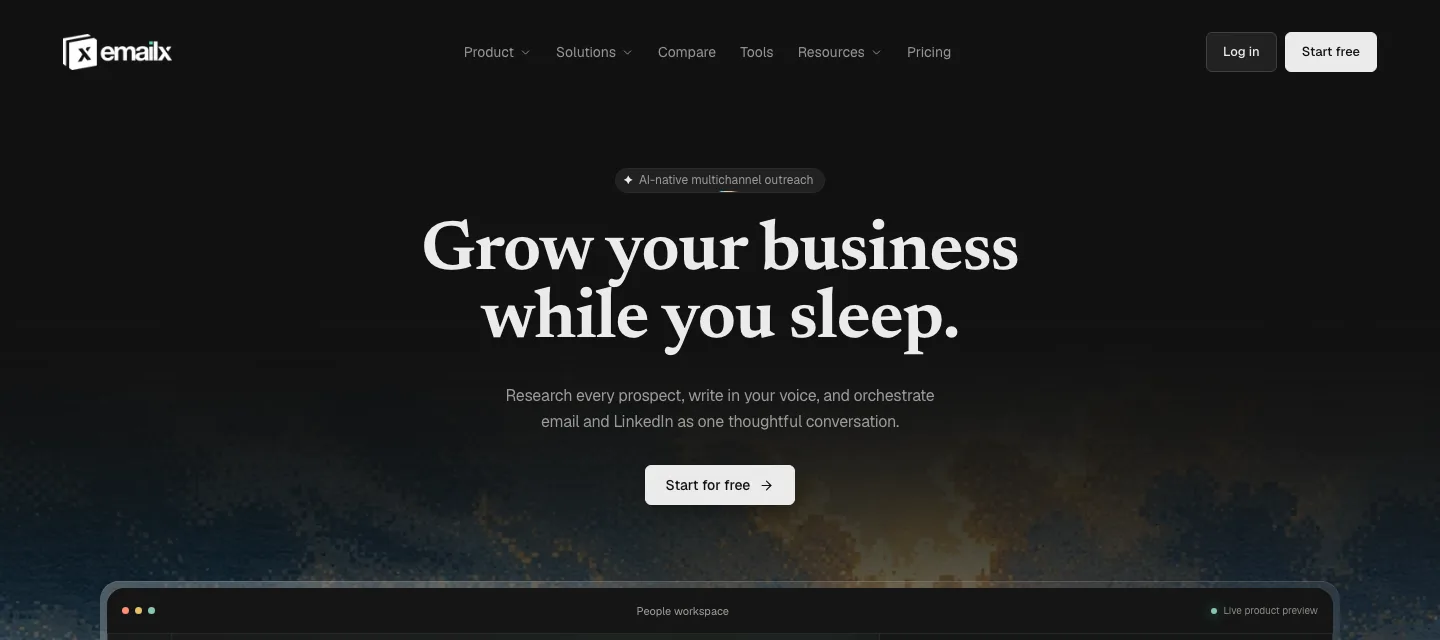
Emailx is built for teams that want a research layer before outreach begins. It brings together prospect context, a reason to write, and examples of the sender's voice before drafting a message.
The workflow keeps email and LinkedIn in the same campaign, with research visible for review before anything sends. Outreach stops when a prospect replies rather than continuing independently across channels.
Compared with Reply.io, Emailx is narrower in channel scope but deeper in the preparation behind each message. It is best for teams that want quality and per-contact context as the primary output, rather than breadth across a full multichannel sequence builder.
Best features
- Research grounded in visible evidence
- Voice-aware email drafting
- Server-side LinkedIn automation
- Reviewable campaign preparation
- Reply-aware campaign learning
Pricing
- 7-day trial, card required (up to 250 emails included)
- Plans scale with sending volume, not seats: email from $29/month annual, email + LinkedIn from $83/month annual
- Enterprise: custom, book a consultation
Reply.io
Overview
 Product overview
Reply.io is one of the most established sales engagement platforms in the market. It covers email, LinkedIn, phone, SMS, and WhatsApp in a single sequence builder, with deep CRM integrations and Jason, its AI assistant, now sold as a separate standalone product.
The platform has 1,448 G2 reviews at 4.6 out of 5 (checked directly, 2026-09-07) and has been in the market since 2014, giving it a large library of playbook templates and a community of experienced users. Its multi-step branch-logic sequence builder gives operators fine-grained control over conditional steps and timing.
Compared with Emailx, Reply.io is the right fit for revenue teams that need multichannel sequences beyond email and LinkedIn, and for whom deep CRM sync with Salesforce or HubSpot is a day-one requirement. The trade-off is that its LinkedIn automation requires a Chrome extension, warm-up is not bundled, LinkedIn is no longer included in the entry plan, and Jason AI SDR Agent 2.0 targets by account-level intent signals rather than researching the individual contact.
Best features
- Email base plan; LinkedIn via Chrome extension is a separate $69/mo/account add-on
- Jason AI SDR Agent 2.0: a $500/month standalone product using intent signals
- Deep two-way CRM sync with Salesforce, HubSpot, and Pipedrive
- Multi-step branch-logic sequence builder with conditional steps
- Large library of playbook templates
Pricing
- Email Volume: from $49/user/month
- LinkedIn automation: +$69/month per account (add-on)
- Multichannel (email+LinkedIn+calls/SMS+WhatsApp): from $89/user/month
- Jason AI SDR Agent: from $500/month, a separate product
- Checked 2026-09-07; verify current tiers on Reply.io's live pricing page before quoting.
Which workflow fits your team?
Start with the work that is difficult today, not the longest feature list.
Choose Emailx if…
You want every message to sound like you wrote it for that specific person, based on current research rather than enriched record fields.
LinkedIn automation should run server-side without a Chrome extension, so accounts face less risk of being flagged at volume.
Email infrastructure and warm-up should be bundled rather than added from a third-party service.
Choose Reply.io if…
Your team actively uses calling, SMS, or WhatsApp as outreach channels alongside email and LinkedIn.
Deep two-way CRM sync with Salesforce, HubSpot, or Pipedrive is a non-negotiable day-one requirement.
Your team needs fine-grained branch-logic sequence control with conditional steps and a large library of pre-built playbooks.
Where Emailx and Reply.io meaningfully differ
The decision becomes clearer when you follow the work from research to reply.
Extension, or autonomous sequence
LinkedIn outreach depends on two things: who initiates the action, and whether the platform can distinguish automated behavior from a real user. A browser extension and a server-side connection send fundamentally different signals, and the distinction compounds at volume.
Emailx runs LinkedIn sequences server-side: connection requests, follow-up messages, and a stop when the prospect replies on either channel, with no browser extension required. Reply.io's LinkedIn automation uses a Chrome extension that requires an open browser to fire sequences. When the machine sleeps, the browser closes, or LinkedIn flags the extension, sequences pause. Reviewers on G2 and Reddit describe this as the single most common point of failure for teams running LinkedIn at any real volume. Teams whose outreach is purely email will not encounter this limitation, but those who rely on LinkedIn should weigh the account risk before choosing.
Template fill, or live research
The difference between template personalization and research-based personalization is not a matter of degree. A template filled from a job title and company name describes who someone is. Per-contact research identifies why this person would read a message sent today, and writes to that reason specifically.
Emailx researches each prospect at the moment it drafts the message: recent LinkedIn signals, company news, and role context. The research stays attached to the draft for review, so the team evaluates the reasoning alongside the wording. Reply.io's Jason has grown into a $500/month standalone 'AI SDR Agent 2.0' that targets accounts using intent signals such as hiring activity and tech usage, which is real progress from a template-fill tool, but Reply.io's own marketing does not claim Jason reads an individual contact's recent posts or activity before writing to them; the personalization is account-level, not per-contact. If the goal is a message that reads as though a person looked at this specific contact today, Emailx is the more direct path.
Warm-up bought separately, or bundled in
Cold email deliverability depends on warming up sending infrastructure before the first campaign runs. Whether a tool handles warm-up or expects the team to configure it from a third-party service affects both startup cost and the accuracy of the all-in monthly spend.
Emailx includes warm-up in every plan. New teams do not need to find, pay for, and connect a warm-up service before their first campaign is ready to send. Reply.io does not bundle warm-up tooling; teams typically add a separate warm-up service, which adds monthly cost and another configuration step before outreach is live. For teams that already run a warm-up service elsewhere, the distinction is minor. For teams starting outreach from scratch or comparing total monthly cost, it is worth accounting for.
Many channels, or two done well
Channel breadth and channel depth are different products. A platform that includes calling, SMS, and WhatsApp alongside email and LinkedIn is useful when those channels are actively used. When they are not, the breadth adds interface weight, pricing tiers, and configuration overhead without adding value to the outreach motion.
Reply.io covers email, LinkedIn, phone, SMS, and WhatsApp in a single sequence builder, which makes it one of the most complete platforms in the category for revenue teams with a multichannel motion that includes calling. Emailx covers email and LinkedIn. It has no dialer, no SMS, no WhatsApp. Teams whose outreach motion includes cold calling or messaging should consider whether the Reply.io stack is worth the additional complexity and cost. Teams whose outreach runs on email and LinkedIn only will find Emailx's narrower focus means a simpler workflow, a faster setup, and a lower total bill.
Per seat, or per contact
How a tool charges determines how cost grows as the team adds people, not just what it costs today. Per-seat and per-credit models produce very different bills as a team scales, and the right model depends on whether usage grows primarily with headcount or with contact volume.
Reply.io charges per user per month for email, and the bill climbs from there: LinkedIn is now a separate $69/month per-account add-on rather than a bundled feature, and Jason AI SDR Agent 2.0 is a standalone $500/month product on top. Reviewers on G2 and Trustpilot consistently describe surprise at the gap between the starting price and the actual bill once channels and seats are added. Emailx uses a plan that scales with how many contacts a team works and which channels it sends on, not how many people are in the workspace. A team that adds a member without adding contact volume pays nothing extra. For a small team sending targeted campaigns rather than high-volume blasts, that model is typically more predictable.
Where each product is not the automatic answer
A good comparison should make the reasons not to switch just as visible.
Where Emailx is not the automatic answer
- If your team actively uses calling, SMS, or WhatsApp as outreach channels, Reply.io covers those channels and Emailx does not.
- Reply.io has mature two-way CRM integrations with Salesforce, HubSpot, and Pipedrive. If this sync is a day-one requirement, Emailx's integrations are less mature.
- Reply.io's multi-step branch-logic sequence builder gives experienced operators conditional control that Emailx's campaign model does not replicate.
Where Reply.io can be the better fit
- Your team's outreach motion includes calling, SMS, or WhatsApp alongside email and LinkedIn.
- Deep two-way Salesforce or HubSpot sync is non-negotiable for your revenue operations workflow.
- Your team is already fluent in Reply.io's sequence builder and the playbook library is a genuine asset in your current campaigns.
Which tool should you choose?
Emailx is the better fit for teams that want per-contact research, a sender voice that reads as human, and LinkedIn automation that runs without a Chrome extension or warm-up add-on. Reply.io is the right choice for revenue teams whose outreach includes calling, SMS, or WhatsApp, and for whom Salesforce or HubSpot sync is a day-one requirement rather than a future addition.
Sources
Verified September 7, 2026. Competitor capabilities and prices change, so each source below records the date it was checked.
- Reply.io pricingChecked September 7, 2026
- Reply.io product overviewChecked September 7, 2026
- Reply.io reviews on G2Checked September 7, 2026
- Reply.io reviews on TrustpilotChecked August 18, 2026
- Reddit r/coldemail, Reply.io discussion threadsChecked August 18, 2026