
 Julien Paltrinieri

Is Emailx the right HeyReach alternative?
Choose Emailx when you need email and LinkedIn running together as one campaign, in one subscription. HeyReach is still LinkedIn-only natively, though it now offers native Instantly and Smartlead integrations to hand a lead to email when LinkedIn goes quiet, but that's still two separate tools with an official bridge, not one. If you'd rather have one product and one price for both channels, Emailx consolidates that into a single campaign context.
Stay with HeyReach when your outreach is pure LinkedIn and you want an interface purpose-built for managing many client LinkedIn accounts with a strong safety record. Its cloud-based architecture keeps accounts well clear of detection thresholds, and for agencies running LinkedIn-only campaigns for multiple clients, that focus is a genuine advantage.
Emailx as an alternative to HeyReach
The practical differences, before the deeper explanation.
| Outreach tool | Rating | Best for | Starting price |
|---|---|---|---|
| Emailx | ⭐⭐⭐⭐⭐ | Founders and sales teams who need email and LinkedIn in one campaign with per-contact AI research | 7-day trial (card required), from $29/month |
| HeyReach | ⭐⭐⭐⭐ | Agencies running pure LinkedIn outreach across multiple client accounts with a safety-first cloud approach | From approximately $79/month per LinkedIn account |
How Emailx differs from HeyReach
A closer look at what each product is designed to help a team do.
Emailx
Overview
 emailx.ai
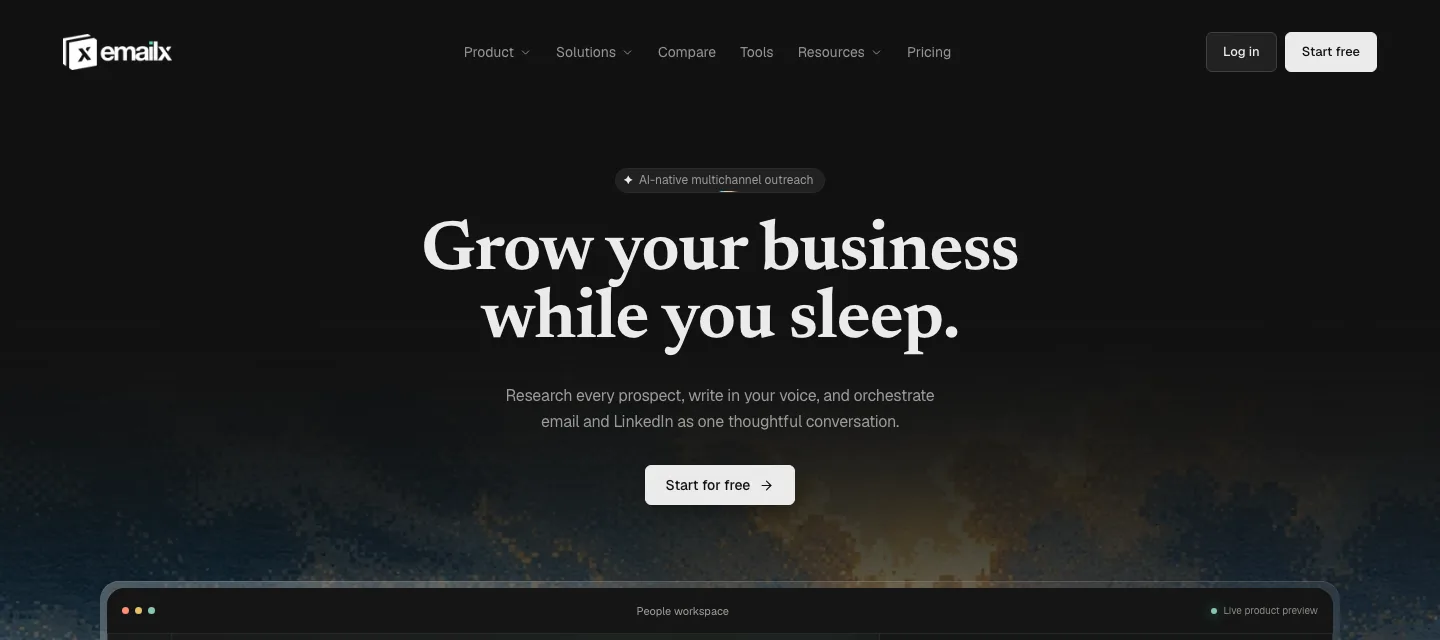
Emailx runs email and LinkedIn as first-class channels in one campaign. There is no separate LinkedIn tool to manage alongside an email platform: the same prospect context, the same reply state, and the same campaign timing govern both channels. When a prospect replies on LinkedIn, the email steps stop. When they reply to an email, the LinkedIn steps stop.
Before writing any outreach message, Emailx reads each contact's LinkedIn profile, recent posts, and visible company signals, then writes a message grounded in something specific to that person. This is not variable enrichment: it is per-contact live research that produces copy that reads as individually written rather than template-filled.
Email infrastructure is included: domains, mailboxes, and warm-up are part of the plan rather than separate tools to configure. LinkedIn runs server-side with no Chrome extension required. For a team whose constraint is having two separate tools for two channels that should behave as one campaign, Emailx is the direct answer.
Best features
- Email and LinkedIn running from one campaign context
- Per-contact AI research before every outreach step
- Server-side LinkedIn automation, no browser extension
- Domains, mailboxes, and warm-up bundled in plan
- Reply-aware across both channels: one reply stops both
Pricing
- 7-day trial, card required (up to 250 emails included)
- Plans scale with sending volume, not seats: email from $29/month annual, email + LinkedIn from $83/month annual
- Enterprise: custom, book a consultation
HeyReach
Overview
 Product overview
HeyReach is a cloud-based LinkedIn automation platform built around one core idea: a single operator managing many LinkedIn accounts from one dashboard without getting them flagged or restricted. It handles LinkedIn connection requests and follow-up message sequences, with a campaign builder, Clay and Apollo integrations, and multi-account rotation that keeps activity patterns within safe limits.
Its safety architecture is a genuine and well-earned strength. Cloud simulation rather than browser injection puts HeyReach in a safer class than extension-based tools, and most reviewers on G2 and Capterra confirm that accounts stay healthy under normal operating conditions. The multi-account dashboard is well-designed for agencies managing several client LinkedIn profiles from one place.
HeyReach is still LinkedIn-only natively; there is no email module, no domain warm-up, and no deliverability tooling of its own, but it now ships native integrations with Instantly and Smartlead specifically to hand a lead to email when LinkedIn goes quiet, checked 2026-09-07. That closes some of the manual-handoff pain this page originally described, though it still means two separate subscriptions and tools rather than one, just with an official bridge between them instead of a DIY export. Personalization works through dynamic variables pulled from list data, including Clay-enriched fields, rather than AI writing per contact. The only 'AI' capability on HeyReach's own site is connecting external agents (Claude, ChatGPT) via MCP, not a built-in research-and-write step.
Best features
- Multi-account LinkedIn management from one dashboard
- Cloud-based architecture with human-paced activity simulation
- Campaign builder with connection requests and follow-up sequences
- Integrations with Clay, Apollo, and major data enrichment tools
- Per-account safety controls and rotation logic
Pricing
- From approximately $79/month per LinkedIn account
- Pricing scales with the number of LinkedIn accounts managed
- Agency pricing available for multi-client setups
What sends teams looking for an HeyReach alternative
The recurring themes in public reviews of HeyReach, before any Emailx comparison.
LinkedIn only, so email is always a second tool, now with an official bridge
HeyReach runs LinkedIn connection requests and follow-up message sequences and nothing else natively. There is no email module, no domain warm-up, and no email sending of its own. It now ships native Instantly and Smartlead integrations, checked 2026-09-07, specifically built to hand a lead to email when the LinkedIn thread goes quiet, a real improvement over the DIY exports this page originally described, but still two separate subscriptions and two separate products, just with an official connector between them.
For agencies that want to offer clients a complete outreach package, the LinkedIn-only architecture still means the tool solves half the problem, even with the integration doing some of the coordination work. Two contact states, two reply inboxes, and two billing relationships remain, for what the prospect experiences as one relationship. Teams that started LinkedIn-only and now need email have an integration path, not a native one.
Per-account pricing that multiplies with each new client
HeyReach's pricing is structured per LinkedIn account, so the cost multiplies as an agency adds clients or team members. What looks like a reasonable starting price for one or two accounts becomes a significant monthly line item for an agency managing eight or ten client LinkedIn profiles. Reviewers who selected HeyReach for its agency positioning describe recalculating the cost after the first scale-up and finding the per-account model is expensive precisely in the scenario the tool is marketed toward.
The per-account model is coherent from a product design perspective: it gives each agency a clear cost-per-client baseline for billing clients. The frustration appears when the aggregate cost becomes the primary reason to reconsider the tool. An agency that pitched a client on LinkedIn outreach before calculating the HeyReach cost at ten accounts is in a different position than one that designed its tech stack around that pricing structure from the start.
Personalization stops at merge variables, not per-contact writing
HeyReach personalizes messages with dynamic variables pulled from list data: the sender writes the template, the tool inserts the variables. More advanced users wire in Clay-enriched fields to populate richer variables, and that does improve the specificity of what lands in the variable slot. But the writing itself is still the sender's template, applied to each contact's data. There is no mechanism that reads a contact's LinkedIn profile or recent posts and produces a message grounded in what that person is working on right now.
Reviewers comparing HeyReach to newer tools flag this consistently. As generic variable-filled messages drive declining reply rates across the industry, agencies that want to stay above the noise need copy that sounds like it was composed for one person, not a template with their name and company substituted in. The Clay integration helps with what goes into the variable, but it does not change the underlying template model that produces the message.
Reporting is functional but basic for an agency tool
Reviewers who want to show clients detailed campaign performance, including reply rates by message step, A/B comparisons across templates, and contact-level engagement history, describe HeyReach's reporting as functional but not deep enough for agency client reporting. Teams that need to identify which sequence step is underperforming, or produce a report that justifies a monthly retainer, frequently describe exporting raw data and building their own views rather than using the native analytics.
For a tool built explicitly for agencies, reporting depth is the feature that most obviously lags the sales positioning. The core multi-account dashboard is well-designed, and the safety controls are robust, but the analytics layer that would let an agency demonstrate campaign ROI to a client is not at the same level of development. This is worth noting for any agency evaluating HeyReach on behalf of clients who want performance transparency.
No email infrastructure of its own, bridged by integration instead
HeyReach has no email warm-up, no domain provisioning, and no deliverability tooling because it doesn't send email itself. For an agency or team that manages separate email infrastructure alongside HeyReach, that infrastructure cost and maintenance burden is additive rather than consolidated. Domain provisioning, mailbox warm-up, and inbox management all sit in a separate product at a separate cost, even with the native Instantly/Smartlead handoff routing leads between them.
This is not a bug in HeyReach: it is a design choice. HeyReach made a deliberate decision to be best-in-class at LinkedIn safety rather than build a mediocre email product, and the integration approach fits that choice: connect to a real email tool rather than build a worse one internally. That trade is correct for teams whose outreach is genuinely LinkedIn-first. For teams who want one product and one bill for both channels rather than two connected ones, the answer is still a different product.
Should your team switch?
Start with the work that is difficult today, not the longest feature list.
Switch to Emailx if…
You need email and LinkedIn running from one campaign, with a shared reply state so a response on either channel stops both.
You want per-contact AI research that reads each prospect's LinkedIn profile and writes something specific to them, not merge variables from enrichment data.
Your per-account HeyReach cost has climbed as you added clients, and a flat pricing model would make the workflow easier to scale.
You are managing separate email infrastructure alongside HeyReach and want to consolidate into one product.
Stay with HeyReach if…
Your outreach is pure LinkedIn and you want an interface purpose-built for managing many client LinkedIn accounts with a strong safety track record.
LinkedIn account safety and cloud-based architecture are the top priority and you do not need email as part of the campaign.
The per-account pricing model fits your agency billing structure and gives you a clear cost-per-client baseline.
What changes when you move from HeyReach to Emailx
The decision becomes clearer when you follow the work from research to reply.
One channel managed safely, or two channels in one campaign
The right question before choosing between a LinkedIn specialist and a multichannel platform is whether your outreach motion actually runs on one channel or two. A team that genuinely works LinkedIn-only will overpay for email infrastructure they do not use. A team that needs both channels and manages them separately will accumulate tool debt that compounds with every new campaign.
HeyReach is a LinkedIn-only platform by deliberate design, and its safety architecture and multi-account dashboard are built specifically for that job. Emailx runs LinkedIn and email from the same campaign context, so a prospect who answers on one channel stops the other automatically. For teams whose constraint is coordinating two tools for two channels that should behave as one relationship, Emailx eliminates the coordination problem at the source.
Variable enrichment, or research that writes for this person
The gap between a message that contains a personal detail and a message that sounds personal is larger than it looks from a feature list. A variable with an enriched company name or job title tells the recipient that someone looked at their record. A message that references something they actually posted last week tells them someone read their work.
HeyReach's personalization model is variable-based: the sender writes the template, enrichment data fills the variables, and each contact gets a version with their details substituted in. Emailx reads each contact's LinkedIn profile and recent activity before writing, then produces copy grounded in what that person is working on now. The operational result is different reply rates, especially as prospect databases mature and recipients have seen enough variable-filled templates to recognize the pattern in the first sentence.
Cost that scales with accounts, or cost that scales with contacts
Per-account pricing and per-contact pricing produce different growth curves. Both are reasonable structures, but they favor different operating models, and the difference becomes significant when an agency adds its tenth client or a sales team starts working a larger list.
HeyReach charges per LinkedIn account, so the cost grows with the number of profiles under management. An agency adding clients adds accounts, and the bill grows linearly with each. Emailx charges based on the contacts you actually work, not the number of LinkedIn profiles running. For a small team or agency where headcount is stable but contact volume varies, the Emailx structure is easier to forecast. For a large agency that wants to price LinkedIn outreach retainers by account and needs transparent cost-per-client, HeyReach's structure is more predictable.
Specialized tool, or consolidated workflow
Adding a specialized tool to a stack is always a tradeoff: the tool does its specific job better than a generalist, but it adds a system to maintain, a login to manage, and a data set to keep in sync with everything else. The right choice depends on whether the specialization is irreplaceable or whether consolidation would produce a better net outcome.
HeyReach's specialization is genuine: LinkedIn safety and multi-account management at the level it provides are hard to replicate in a generalist product. For a pure LinkedIn agency, that specialization is worth the stack complexity. For a team managing a second email tool, a second inbox, and a second campaign setup alongside HeyReach, the consolidation argument for a unified product like Emailx is the calculation to run first. The break-even is usually one or two client accounts where the coordination cost of two tools exceeds the safety advantage of a specialist.
Basic reporting, or client-ready campaign analytics
The level of reporting a team needs is often set by who they report to. An individual SDR running their own LinkedIn sequences needs reply rates and a pipeline view. An agency presenting campaign performance to paying clients needs step-level performance, A/B comparisons, and exportable data that tells a coherent story about ROI.
HeyReach's reporting covers the basics, and reviewers consistently describe it as enough to operate the tool but not deep enough to present to a client. For a founder or single operator, that threshold is fine. For an agency that bills clients a monthly retainer and needs to justify the results, the analytics gap is worth evaluating before committing to the platform. Emailx's reporting is more granular at the sequence and step level, though the right measure is always whether the output gives you what you need to have the client conversation you actually have.
When switching is not the right move
A good comparison should make the reasons not to switch just as visible.
When Emailx is not the right switch
- Your outreach is genuinely LinkedIn-only and you want the best LinkedIn safety record and multi-account management interface in the category.
- You run an agency where per-account pricing makes cost-per-client billing transparent and your clients pay for LinkedIn coverage specifically.
- HeyReach's Clay and Apollo integrations are central to your enrichment workflow and you need that specific integration depth.
- You need native LinkedIn-only features like advanced connection request controls that a generalist multichannel platform may not prioritize.
When an Emailx trial is worth running
- You are managing a separate email platform alongside HeyReach and want to see if one product can replace the combination.
- Per-account HeyReach costs have grown to the point where the total exceeds what a unified product would cost for the same contact volume.
- You want messages that sound individually written rather than template-filled with enriched variables.
- A prospect has answered on email rather than LinkedIn and you had no coordinated way to stop the LinkedIn steps automatically.
Should you switch from HeyReach?
Emailx is the stronger HeyReach alternative when you need email and LinkedIn running from one campaign: per-contact research, coordinated multichannel sequences with a shared reply state, and a pricing model that scales with contacts rather than accounts. HeyReach is the right choice when your outreach is pure LinkedIn, LinkedIn account safety is the top priority, and you want a dashboard built specifically for managing many client LinkedIn profiles. Test Emailx on a campaign where email and LinkedIn should have been one coordinated sequence, and keep HeyReach for the clients where LinkedIn-only is the deliberate brief.
Sources
Verified September 7, 2026. Competitor capabilities and prices change, so each source below records the date it was checked.
- HeyReach pricingChecked September 7, 2026
- HeyReach multichannel (Instantly/Smartlead) integration pageChecked September 7, 2026
- HeyReach reviews on G2Checked September 7, 2026
- Reddit agency community and r/coldemail, HeyReach discussionsChecked August 20, 2026