
 Julien Paltrinieri

Is Emailx the right Salesforge alternative?
Choose Emailx when you came to Salesforge for autonomous email and LinkedIn together and the multichannel sequencer has been unreliable, or when the module stack requires more setup and ongoing assembly than your team wants to manage, or when the cost of adding Agent Frank for autonomous outreach is more than you expected to pay on top of the base subscription.
Stay with Salesforge when high-volume sending infrastructure is the operating advantage you depend on: dedicated IPs, multi-domain rotation, and provisioning large numbers of mailboxes at agency scale, where its deliverability tooling is a genuine strength. If bundled unlimited warm-up is the deciding feature, Salesforge has a clear edge there too.
Emailx as an alternative to Salesforge
The practical differences, before the deeper explanation.
| Outreach tool | Rating | Best for | Starting price |
|---|---|---|---|
| Emailx | ⭐⭐⭐⭐⭐ | Founders and small sales teams who want autonomous email and LinkedIn in one product with per-contact research included | 7-day trial (card required), from $29/month |
| Salesforge | ⭐⭐⭐⭐ | High-volume and agency teams that need dedicated-IP sending infrastructure and multi-domain rotation across many client accounts | Trial · Advertised from approximately $40/month, higher in practice |
How Emailx differs from Salesforge
A closer look at what each product is designed to help a team do.
Emailx
Overview
 emailx.ai
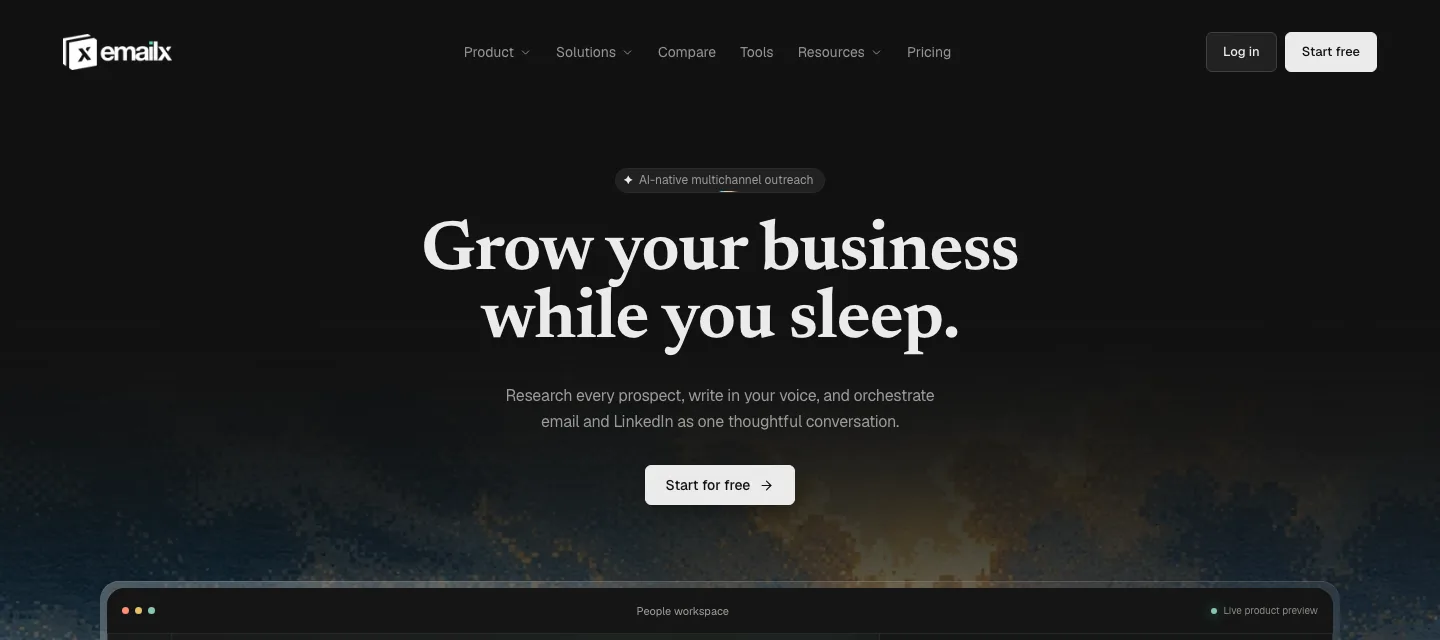
Emailx is a single product that runs email and autonomous LinkedIn from the same campaign. There is no separate module to provision for sending, warm-up, or inbox management, and the autonomous outreach motion is what you buy rather than an expensive tier layered on top.
The workflow puts per-contact research before writing. Emailx reads each contact's LinkedIn activity and company context, keeps that evidence beside the draft for review, and stops both email and LinkedIn steps the moment a prospect replies. LinkedIn runs server-side with no browser extension required.
Compared with Salesforge, Emailx trades infrastructure depth for a simpler operating model and deeper per-contact preparation. It fits founders and small sales teams who want autonomous outreach running in an afternoon rather than a module ecosystem to configure over several weeks.
Best features
- Email and autonomous LinkedIn in one campaign
- Per-contact research with evidence kept beside the draft
- Server-side LinkedIn, no browser extension
- Domains, mailboxes, and warm-up bundled in plan
- Reply-aware sequences that pause on response from either channel
Pricing
- 7-day trial, card required (up to 250 emails included)
- Plans scale with sending volume, not seats: email from $29/month annual, email + LinkedIn from $83/month annual
- Enterprise: custom, book a consultation
Salesforge
Overview
 Product overview
Salesforge is a family of outreach modules: Mailforge for sending, Infraforge for dedicated IPs, Primeforge for domain provisioning, Warmforge for unlimited warm-up, and Primebox for inbox management. On top of that sits Agent Frank, an autonomous AI SDR that sources prospects, writes personalized outreach, and books meetings, sold as a separate module at roughly $499 to $599 a month.
Its infrastructure is a genuine strength. Dedicated IPs, multi-domain rotation, and the ability to provision large numbers of Google or Microsoft mailboxes make it well suited to agencies managing high sending volume across many client accounts. Warm-up is bundled and unlimited across its plans.
Compared with Emailx, Salesforge is broader on infrastructure and heavier to assemble. Reviewers on G2 and Trustpilot consistently describe a one to three week ramp before the modules work together well, and the multichannel sequencer that combines email and LinkedIn is one of the most cited pain points in those reviews.
Best features
- Modular stack: Mailforge, Infraforge, Primeforge, Warmforge, Primebox
- Dedicated IPs and multi-domain rotation for high-volume sending
- Mailbox provisioning at scale across client accounts
- Unlimited warm-up bundled across plans
- Agent Frank autonomous AI SDR as a separately priced module
Pricing
- Trial available
- Advertised from approximately $40/month
- Realistic floor near $90/month once infrastructure modules are added
- Agent Frank: approximately $499 to $599/month for around 1,000 active contacts
- Enterprise: custom
What sends teams looking for an Salesforge alternative
The recurring themes in public reviews of Salesforge, before any Emailx comparison.
The module stack is confusing to assemble and maintain
Salesforge is not one product: it is a family of separately branded modules that a user has to understand and wire together before outreach can begin. Around fifteen public reviewers flag the learning curve directly, and multiple alternative roundups describe onboarding as overwhelming. Reviewers report the full platform taking one to three weeks to understand well enough to use confidently.
For a founder or a small team that wants outreach running this week, the glossary of forge-named modules is friction before any value appears. The module design is deliberate and it buys real capability for teams that need it, but it is the most consistently cited reason users search for Salesforge alternatives.
The email and LinkedIn sequencer is reported as buggy
Users who bought Salesforge specifically for combined email and LinkedIn outreach report reliability problems with the multichannel sequencer, describing it as buggy and unfinished. Sequences pause without clear feedback, LinkedIn steps fail silently, and the tool that was meant to coordinate both channels ends up requiring manual monitoring.
This is the most strategically important theme for anyone searching for a Salesforge alternative with LinkedIn, because it is exactly the motion Emailx is built to run reliably. The issue is not that Salesforge lacks a multichannel sequencer: it has one. The complaint is that the sequencer does not hold together in practice the way the feature page suggests it will.
The real cost is much higher than the headline, and Agent Frank is a large jump
Salesforge advertises a starting price around $40 a month, but reviewers note the realistic floor is closer to $90 once infrastructure and domain modules are included. The autonomous AI SDR, Agent Frank, is a separate and substantially larger commitment at roughly $499 to $599 a month for around 1,000 active contacts, and sources disagree on the exact current figure, which itself reads as pricing inconsistency.
A team that assumed they were buying an AI outreach platform for $40 a month and found the autonomous capability they wanted was several hundred dollars more has a legitimate grievance. The modular structure is coherent from a product design perspective, but it makes the true cost of the thing a buyer actually wants hard to see before signing up.
Reporting is described as thin relative to the price
Around seven public reviewers call out missing analytics: limited reporting depth and no attribution or revenue-level views. Teams that want to understand what is actually working, beyond open and reply rates, find the reporting layer does not match what a platform priced this way should provide.
This theme is worth noting because it is not about a missing feature in a cheap tool. It is the frustration of paying for a serious infrastructure platform and not being able to answer the question of which campaign or sequence is actually driving results.
Credits get spent on unverified contacts
Reviewers flag that the platform lacks a strong upstream data-verification layer, so validation credits and sends are spent on invalid or outdated contacts. The built-in contact database is broad, but the quality of any given export varies and there is no strong built-in guard against wasting outreach budget on bad records.
For teams that rely on the Salesforge database as their prospect source, this is a direct cost: every bounced contact consumes the send credit that found it. Emailx does not solve this problem because it has no built-in database. You bring contacts from a CSV, your CRM, or a data provider. If built-in prospect sourcing is a real part of why you chose Salesforge, that is a genuine reason to stay.
Should your team switch?
Start with the work that is difficult today, not the longest feature list.
Switch to Emailx if…
You came to Salesforge for email and LinkedIn in one sequence, and the multichannel sequencer has been unreliable in practice.
You are a founder or small team and the module stack is more system than you want to run and maintain.
You want autonomous outreach included in the core product without a separate several-hundred-dollar monthly tier.
Per-contact research and personalization matter more to your reply rate than raw sending volume.
Stay with Salesforge if…
High-volume sending infrastructure is your priority: dedicated IPs, multi-domain rotation, and provisioning many mailboxes across client accounts.
You run an agency managing cold email across multiple client accounts and need per-client sub-account structure with bundled unlimited warm-up.
You have the time to assemble and configure the modules and want the infrastructure depth and control that the separated stack provides.
What changes when you move from Salesforge to Emailx
The decision becomes clearer when you follow the work from research to reply.
One product, or a module ecosystem to assemble
Before any message sends, a team has to get the tool into a working state. Whether that means one setup step or several sequential provisioning decisions shapes how long it takes to reach a first campaign and how much attention the platform requires on an ongoing basis.
Emailx is one setup: connect a mailbox and a LinkedIn account, describe the campaign, and start sending. Salesforge is assembled from separately branded pieces, and reviewers consistently describe a one to three week ramp before the modules are connected and working together. For an agency that needs infrastructure at scale and has a team to configure it, that ramp buys real capability. For a founder who wants outreach live this week, it is overhead before any value appears.
Reliable multichannel, or a sequencer to monitor
A team that chooses a platform for email and LinkedIn in one sequence is buying the reliability of that combined motion, not just its presence on a feature list. A sequencer that pauses silently is more expensive than one that was never advertised, because the team planned their workflow around it.
Emailx was built around email and server-side LinkedIn in a single sequence, and the LinkedIn steps fire without an open browser or a browser extension. Salesforge offers a multichannel sequencer that combines email and LinkedIn, but it is consistently the most cited pain point in public reviews. Users report sequences pausing without clear feedback and LinkedIn steps failing. If combined email and LinkedIn is the core of your outreach, this reliability difference is the one to weigh most carefully.
Included autonomous motion, or a separate expensive tier
Autonomous outreach, where the tool researches a contact, writes the message, and runs the follow-up, is increasingly what buyers actually want from an AI outreach platform. Whether that motion is part of the core product or a premium add-on changes the real price by an order of magnitude.
In Emailx, autonomous per-contact research, email writing, and LinkedIn sequences are the product. In Salesforge, the autonomous motion is Agent Frank, a separately priced module at roughly $499 to $599 a month for around 1,000 active contacts, on top of the base subscription and infrastructure. For a team that only wants scheduled sequences, the separation is fine. For a team that wants the autonomous motion, the capability that looked like $40 a month on the pricing page is several hundred dollars a month once Agent Frank is added.
Per-contact research, or field-driven copy
A personal detail only helps when it gives this specific person a credible reason to read a message sent today. The useful question is not whether a message contains a variable, but whether the reasoning behind it would survive the recipient's attention for more than a second.
Emailx researches each contact at the moment it drafts: recent LinkedIn signals, company context, and role, with the evidence kept beside the draft for review. Salesforge generates AI copy from standard record fields and enrichment data, and Agent Frank automates outreach on top of that same field-driven base. The gap tends to show once a list runs past a few hundred contacts, where field-filled openers read as templated. If weak personalization is what is capping your reply rate, Emailx addresses it more directly.
One predictable price, or a bill that climbs with each module
The number on a pricing page only matters if it is close to the number a team actually pays at the end of the first month. A low headline that excludes required modules understates the real commitment, and the surprise tends to arrive after the first invoice rather than before signing.
Salesforge advertises from around $40 a month, and a functional setup pulls in infrastructure modules that lift the realistic floor to roughly $90. Add Agent Frank and the monthly figure clears several hundred dollars. Emailx is one price for email and autonomous LinkedIn with research and warm-up included, so the quoted plan is close to the actual bill. Where Salesforge earns its cost is high-volume infrastructure; for teams that do not need dedicated-IP sending at scale, the simpler single price is easier to forecast and usually lower for the complete workflow.
When switching is not the right move
A good comparison should make the reasons not to switch just as visible.
When Emailx is not the right switch
- Your team needs dedicated-IP infrastructure, multi-domain rotation, and mailbox provisioning at high volume. Salesforge's sending stack is more mature and purpose-built for that.
- You run an agency managing cold email across multiple client accounts and need per-client sub-account structure with bundled unlimited warm-up on every domain.
- Salesforge's built-in contact database is how you source prospects. Emailx has no database and will not replace it.
- You need the documented infrastructure playbooks and the larger community of Salesforge users to configure complex deliverability setups.
When an Emailx trial is worth running
- You chose Salesforge specifically for email and LinkedIn together, and the multichannel sequencer has been pausing or misfiring.
- The module stack has taken longer to set up than expected, and you are still not confident it is running correctly.
- You looked at Agent Frank's price and decided autonomous outreach is too expensive as a separately billed tier.
- Your reply rates have not improved despite AI copy, and you suspect the messages still read as templated rather than researched.
Should you switch from Salesforge?
Emailx is the closer fit when you want autonomous email and LinkedIn in one product without assembling a module stack and without a separate autonomous SDR tier: per-contact research, coordinated multichannel sequences that run reliably, and a single predictable price. Salesforge is the stronger choice when high-volume sending infrastructure is the priority, when you run an agency with dedicated-IP requirements and per-client sub-account needs, or when bundled unlimited warm-up is the deciding feature. Test Emailx on the specific workflow the Salesforge multichannel sequencer was meant to replace, and keep the existing infrastructure running while you compare.
Sources
Verified September 7, 2026. Competitor capabilities and prices change, so each source below records the date it was checked.
- Salesforge pricingChecked September 7, 2026
- Salesforge reviews on G2Checked September 7, 2026
- Salesforge reviews on TrustpilotChecked August 19, 2026
- Reddit r/coldemail, Salesforge and Agent Frank discussionsChecked August 19, 2026