
 Julien Paltrinieri

Is Emailx the right La Growth Machine alternative?
Choose Emailx when you came to La Growth Machine for LinkedIn and email automation, and the combination of per-identity pricing, template-level AI writing, and a workflow builder that takes real time to configure has become more friction than the tool is worth. Emailx researches each contact from their LinkedIn profile before writing, runs email and LinkedIn from one campaign context block, and charges one predictable price regardless of how many LinkedIn accounts or seats you add.
Stay with La Growth Machine when AI voice messages on LinkedIn are central to your outreach, when you want granular, hand-built control over every branch in a multichannel sequence, or when you need a Twitter/X channel or in-sequence phone calls alongside email and LinkedIn. LGM is a genuinely capable product and those specific capabilities are ones Emailx does not match.
Emailx as an alternative to La Growth Machine
The practical differences, before the deeper explanation.
| Outreach tool | Rating | Best for | Starting price |
|---|---|---|---|
| Emailx | ⭐⭐⭐⭐⭐ | Founders and sales teams who want per-contact AI research, email and LinkedIn from one campaign, and one predictable price | 7-day trial (card required), from $29/month |
| La Growth Machine | ⭐⭐⭐⭐ | Teams that need AI voice messages on LinkedIn, granular branching workflow control, or Twitter/X and phone-call channels in a single sequence | Basic from EUR 50/identity/month (annual) |
How Emailx differs from La Growth Machine
A closer look at what each product is designed to help a team do.
Emailx
Overview
 emailx.ai
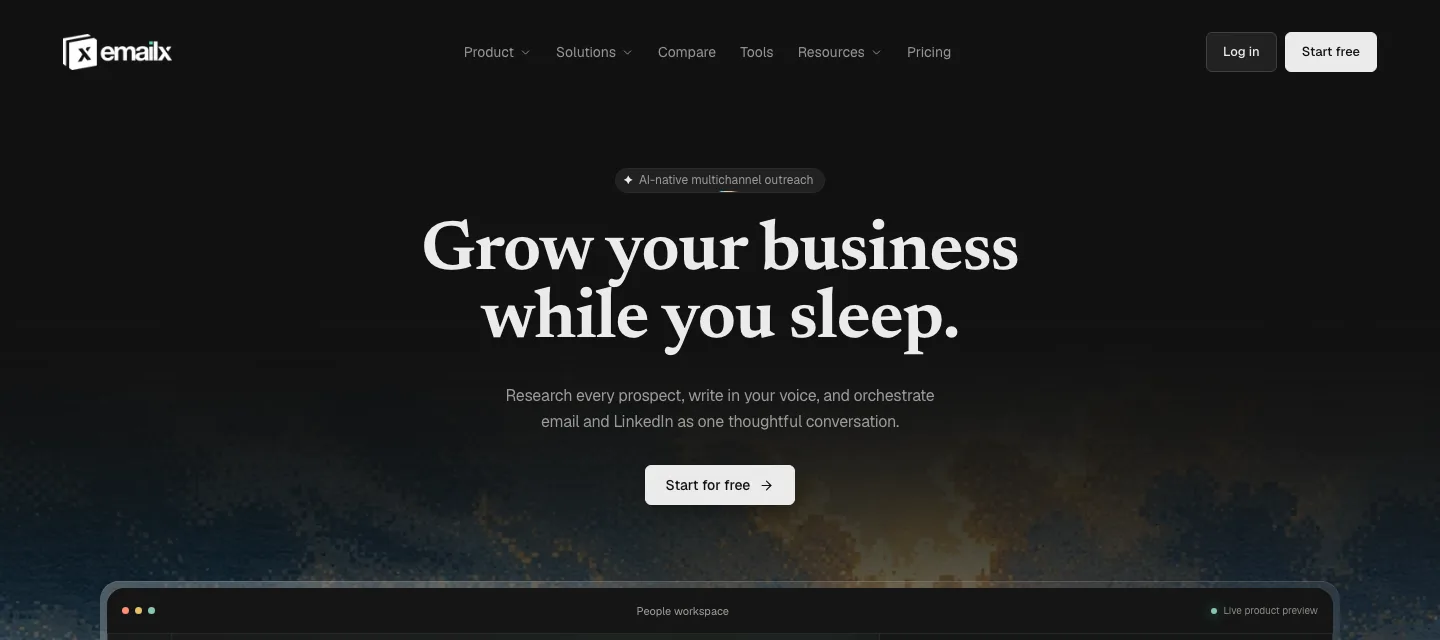
Emailx is built around the research that happens before a message is written. It reads each contact's LinkedIn profile, recent posts, and visible company signals, then writes copy grounded in something specific to that person. You provide a campaign context block once: who you are reaching, why, and what you are offering. Emailx handles the per-contact research and writing from there.
Email and LinkedIn run from the same campaign. There is no separate sequence to build for each channel and no hand-crafted branching logic to maintain. When a prospect replies on either channel, the sequence stops. LinkedIn automation runs server-side, with no Chrome extension and no browser to leave open.
Pricing is one predictable plan regardless of how many LinkedIn accounts or team members are involved. For a growing team or an agency adding client LinkedIn accounts, the bill does not climb with each identity added.
Best features
- Per-contact AI research from LinkedIn profile and company signals
- Email and LinkedIn running from one campaign context block
- Server-side LinkedIn automation, no Chrome extension required
- Reply-aware sequences that stop on response from either channel
- Domains, mailboxes, and warm-up bundled in plan
Pricing
- 7-day trial, card required (up to 250 emails included)
- Plans scale with sending volume, not seats: email from $29/month annual, email + LinkedIn from $83/month annual
- Enterprise: custom, book a consultation
La Growth Machine
Overview
 Product overview
La Growth Machine is a French cloud-hosted multichannel sales automation platform that runs LinkedIn, email, Twitter/X, and phone-call steps inside a visual, drag-and-drop workflow builder. Founded around 2019, it became a favorite among European SMBs, agencies, and sales teams that wanted LinkedIn and email outreach in one place rather than two separate tools. Its most distinctive feature is AI voice messages: you record a voice sample, LGM clones it, and the platform sends personalized LinkedIn voice notes at scale.
LGM runs server-side, so LinkedIn actions do not require a browser extension. It includes lead enrichment to find emails and contact data on imported prospects, and its workflow builder supports genuine branching logic with multiple channels, conditions, and delays in one sequence. G2 reviewers rate it 4.6 out of 5 across 57 reviews, with ease of use and LinkedIn integration drawing the most consistent praise, and software bugs and technical issues the most consistent complaint.
The recurring friction points in reviews are concentrated in three areas: per-identity pricing that grows with every LinkedIn account and seat, an AI writing layer that optimizes templates rather than researching and writing per contact, and campaign-execution bugs that affect teams running time-sensitive sequences at volume.
Best features
- AI voice messages with voice cloning (LinkedIn, signature feature)
- Visual drag-and-drop workflow builder with branching logic
- LinkedIn, email, Twitter/X, and phone-call steps in one sequence
- Server-side LinkedIn, no browser extension required
- Lead enrichment with waterfall contact discovery
- GDPR-focused, European provenance, French and English support
Pricing
- Basic: EUR 50/identity/month (annual, 2 months free), up to 3 identities
- Pro: EUR 100/identity/month (annual), unlimited identities
- Ultimate: EUR 150/identity/month (annual), unlimited identities, adds CRM sync and Twitter/X
- 14-day free trial, no card required; checked directly on LGM's live pricing page, 2026-09-07
What sends teams looking for an La Growth Machine alternative
The recurring themes in public reviews of La Growth Machine, before any Emailx comparison.
Per-identity pricing grows with every account and seat
La Growth Machine charges per identity: every LinkedIn account needs its own license, and every additional seat adds another identity to the bill. Confirmed tiers run from EUR 50 per identity per month on the annual Basic plan up to EUR 150 on Ultimate. A five-person team on the Pro tier runs EUR 500 per month at the listed rate, before add-ons. For a growing agency running several client LinkedIn accounts alongside its own, the bill scales with every account added.
This is the most common trigger for a La Growth Machine alternative search in 2026, and the pattern in reviews is consistent: a team that started with two or three identities finds the bill has grown substantially by the time they have scaled. The per-identity model is coherent from LGM's perspective, but it means that a team's outreach ambition directly inflates its vendor cost in a way that is difficult to forecast at signup.
The AI writing optimizes your template rather than researching each contact
LGM's Magic Messages uses AI to rewrite and improve the copy you provide and to adjust tone. What it does not do is read a prospect's LinkedIn profile, recent posts, or company context and write a message grounded in something specific to that person. Reviewers describe the AI as genuinely useful for polishing a template but not as a per-contact research and writing engine.
As cold-email reply rates decline across the industry, the gap between a better-worded template and a message that references what someone actually posted last week becomes more visible. Teams whose sequences were performing reasonably on LGM two years ago and are now seeing declining reply rates are often hitting this ceiling rather than a volume ceiling. The tool sends reliably; the problem is that the copy, however polished, still reads as template-based to the people receiving it.
Campaign execution bugs are the most-cited complaint across G2 and Capterra
Across G2 and Capterra, the most frequent negative theme is reliability: messages not sending on schedule, contact sync errors, and lag in the workflow builder. LGM is well-rated overall, so these are not deal-breakers for most users. For teams running time-sensitive campaigns at volume, however, an unpredictable send schedule has a direct cost: a sequence meant to arrive Monday morning that pauses over the weekend because of a sync error is a meaningful problem, not a minor inconvenience.
Reviewers who flag execution bugs most forcefully are typically those running LGM at scale, across multiple identities, with sequences that depend on precise timing. The issue appears to be less common for smaller deployments, but for the teams most invested in LGM's capabilities, it is also the most damaging.
CRM sync and the Twitter/X channel are locked behind the highest tier
HubSpot and Pipedrive sync, the Twitter/X channel, and unlimited campaigns are all gated to LGM's Ultimate plan. Reviewers note that putting CRM integration behind the most expensive per-identity tier feels dated: for teams that need their outreach activity to appear in their CRM without manually exporting, the only path is the most expensive identity license. Every team member on the sequence has to be on Ultimate to benefit.
This gating creates a specific frustration for teams that assumed CRM sync would be a standard feature rather than a top-tier unlock. The cost per identity on Ultimate is roughly three times the Basic cost, which means the decision to add CRM sync also means tripling the per-identity bill for every seat.
The workflow builder is powerful, but it is a real investment to use well
The same visual builder that power users consistently praise in reviews is also the feature newer LGM users struggle with most. Designing branching multichannel sequences by hand takes meaningful time to learn, and once a sequence is built, it requires ongoing maintenance as conditions change. Teams that wanted outreach to run without becoming a project find LGM heavier than they expected.
This is not a flaw in LGM's design: it is a deliberate trade, and teams that value granular control should weight the workflow builder as a genuine strength. The issue is that the complexity is not optional. Even a simple two-channel sequence involves the workflow builder, and teams that want to iterate quickly often find the builder adds friction that a simpler campaign-context model would not.
Should your team switch?
Start with the work that is difficult today, not the longest feature list.
Switch to Emailx if…
Your per-identity bill has grown as you added LinkedIn accounts or team members and you want one predictable price for the full email and LinkedIn motion.
You want AI that researches each contact and writes per contact from their LinkedIn profile and company signals, not AI that optimizes a template you still have to write.
You found LGM's workflow builder capable but heavier to configure and maintain than you want, and you would rather describe a campaign once and let the tool run it.
You have hit recurring campaign-execution bugs and want simpler, more predictable sequence behavior.
You do not need AI voice messages on LinkedIn, a Twitter/X channel, or in-sequence phone calls.
Stay with La Growth Machine if…
AI voice messages are central to your LinkedIn outreach. LGM's cloned-voice LinkedIn notes are genuinely distinctive and Emailx has no voice equivalent.
You want granular, hand-built control over branching multichannel sequences and find LGM's visual builder a genuine asset.
You need a Twitter/X channel or in-sequence phone-call steps alongside email and LinkedIn.
European hosting, GDPR-focused design, or French-language support are requirements for your team or your clients.
Lead enrichment is a core part of your workflow and you want waterfall contact discovery bundled in the platform.
What changes when you move from La Growth Machine to Emailx
The decision becomes clearer when you follow the work from research to reply.
Per-contact research and writing, or template optimization
The most important difference between LGM and Emailx is where the AI starts its work. LGM's Magic Messages receives the template you wrote and improves it: the copy is better worded, the tone is adjusted, and the output is a stronger version of the message you drafted. The message still starts from your template and fills in any variables you configured. What does not happen is that the platform reads what a specific prospect is working on now and produces a message grounded in that person's current context.
Emailx starts from the prospect rather than the template. Before writing any message, it reads the contact's LinkedIn profile, recent posts, and visible company signals, and produces copy grounded in something specific to that person. You provide the campaign context once: who you are reaching, why you are reaching them, and what you offer. Emailx handles the per-contact research and writing from there. For the LGM user whose reply rates have plateaued despite good template copy, this distinction is usually the underlying reason. The messages are polished and correctly toned; the problem is that they still read as templates to the people receiving them.
One predictable price, or a bill that scales with every identity
La Growth Machine's per-identity pricing model is coherent for what LGM is, and it works well for small teams with a stable account count. The friction appears as teams grow: adding a new team member, onboarding a new client LinkedIn account, or expanding to a second sending identity each adds a new per-identity line to the invoice. Reviewers consistently describe a moment where they added the third or fourth identity and did the math on a year of growth, and the figure was higher than expected.
Emailx is one price for the full email and LinkedIn motion, regardless of how many LinkedIn accounts or team members are involved. The specific figure is on the Emailx pricing page. The positioning is not that Emailx is categorically cheaper in every configuration, but that the price is predictable in a way that per-identity billing is not. For a growing team or an agency adding client accounts, the difference in forecastability often matters as much as the difference in the dollar amount.
A campaign context block, or a hand-built branching workflow
Getting to a first campaign involves different work in each product. LGM asks you to design the sequence in the visual workflow builder: which channels, in what order, with what conditions, delays, and branching logic for each outcome. For teams that want that level of control, the builder is genuinely excellent, and reviewers who use it fluently praise it consistently. For teams that want outreach running this week without spending time in a sequence designer, the builder adds friction before value appears.
Emailx uses a campaign context block rather than a sequence builder. You describe the outreach once: who the audience is, what you are offering, and why it is relevant to them. Emailx handles the per-contact research, writing, and channel steps from that description. The trade is granular control for operational simplicity. Teams that found LGM capable but heavier than they expected to maintain tend to find that the context-block model matches how they wanted to work from the start.
AI voice messages on LinkedIn, or not
La Growth Machine's cloned-voice LinkedIn notes are its most distinctive capability and the feature with the clearest, most consistent evidence behind it. You record a voice sample, LGM clones it, and the platform sends personalized voice notes at scale. Reviewers report roughly double the reply rate versus text LinkedIn messages. This is LGM's genuine competitive advantage, and it is one that is not currently available in Emailx.
For teams whose outreach depends on LinkedIn voice notes, this comparison ends here: LGM is the right tool and Emailx is not a substitute. The rest of this page is relevant to teams that want email and LinkedIn text outreach with per-contact AI research and predictable pricing, and for whom the voice capability is a nice-to-have rather than a core part of the workflow.
Predictable send behavior, or a sequencer to monitor
A sequencer that runs reliably without monitoring is the baseline expectation, and for most LGM users the sequencer delivers that. The friction appears at scale and in time-sensitive campaigns: messages not sending on schedule, contact sync errors, and workflow-builder lag are the most-cited complaints across G2 and Capterra for teams running multiple identities at volume. LGM's overall ratings are genuinely positive, so these are not universal experiences. They are concentrated among the users running the platform hardest.
Emailx is a simpler execution model, which both limits its configurability and reduces the surface area for execution failures. You describe the campaign once, and the send behavior follows that description without a hand-built workflow to drift or a multi-identity sync to maintain. For the LGM user who is monitoring sequences because they have learned not to trust them unsupervised, the simpler model is worth evaluating, even at the cost of giving up branching logic.
When switching is not the right move
A good comparison should make the reasons not to switch just as visible.
When Emailx is not the right switch
- AI voice messages on LinkedIn are a core part of your outreach motion. LGM's cloned-voice notes are a genuine differentiator with documented impact on reply rates, and Emailx has no equivalent.
- You want granular, hand-designed branching sequences with multiple channels, conditions, and delays per step. Emailx's campaign context block is simpler by design.
- Your workflow includes Twitter/X outreach or in-sequence phone calls alongside email and LinkedIn. Emailx focuses on email and LinkedIn.
- You need lead enrichment bundled in the platform. Emailx does not include a waterfall contact finder; you bring contacts from a CSV or your own data source.
- European hosting, GDPR compliance documentation, or French-language support are hard requirements.
When an Emailx trial is worth running
- Your per-identity bill has grown as you added LinkedIn accounts or team members and the forecast for the next year of growth is higher than you want to pay.
- Reply rates have plateaued despite well-maintained LGM sequences, and you suspect the copy still reads as template-based even when well polished.
- You have spent more time in LGM's workflow builder than you expected and want outreach that runs from a simpler description without ongoing sequence maintenance.
- Campaign execution has been unreliable enough that you are monitoring sequences that should run unsupervised.
Should you switch from La Growth Machine?
La Growth Machine is the right tool when AI voice messages on LinkedIn are part of the outreach motion, when granular visual workflow control is what your team wants, or when Twitter/X and phone-call channels need to sit alongside email and LinkedIn. It is a genuinely capable multichannel platform with a strong track record in European markets. Emailx is the closer fit when the core frustration is that the per-identity bill grows with every account added, that the AI writing produces a better template rather than a per-contact message, or that the workflow builder takes more time to configure and maintain than the team wants to spend. Run Emailx on one campaign where you need email and LinkedIn with per-contact research and a predictable single price, and compare that against the full LGM bill for the same seats and identities.
Sources
Verified September 7, 2026. Competitor capabilities and prices change, so each source below records the date it was checked.
- La Growth Machine pricing pageChecked September 7, 2026
- La Growth Machine reviews on G2Checked September 7, 2026
- Third-party review roundupChecked August 21, 2026
- Third-party LGM review analysisChecked August 21, 2026
- Reddit r/coldemail, La Growth Machine discussionsChecked August 21, 2026