
 Julien Paltrinieri

Is Emailx the right Artisan alternative?
Choose Emailx when the reason you are leaving Artisan is Ava's default autonomous-send posture producing generic-sounding copy at volume, or pricing you can't see without a sales call. Emailx keeps research visible next to every draft and reviews before sending by default, with autopilot available once you trust a segment, and pricing that's on the site.
Stay with Artisan when you want to replace BDR headcount outright rather than equip a smaller team, and you're willing to accept its autonomous-by-default model, its broader single-platform surface (dialer, CRM sync, enrichment), and its enterprise-grade rollout support to get there.
Emailx as an alternative to Artisan
The practical differences, before the deeper explanation.
| Outreach tool | Rating | Best for | Starting price |
|---|---|---|---|
| Emailx | ⭐⭐⭐⭐⭐ | Teams that want research visible next to every draft, review before sending by default, and pricing they can see today | 7-day trial (card required), from $29/month |
| Artisan | ⭐⭐⭐⭐4.1/5 G2 · 4.2/5 Trustpilot | Teams replacing BDR headcount outright and comfortable with autonomous-by-default sending | Sales-gated, no public pricing |
How Emailx differs from Artisan
A closer look at what each product is designed to help a team do.
Emailx
Overview
 emailx.ai
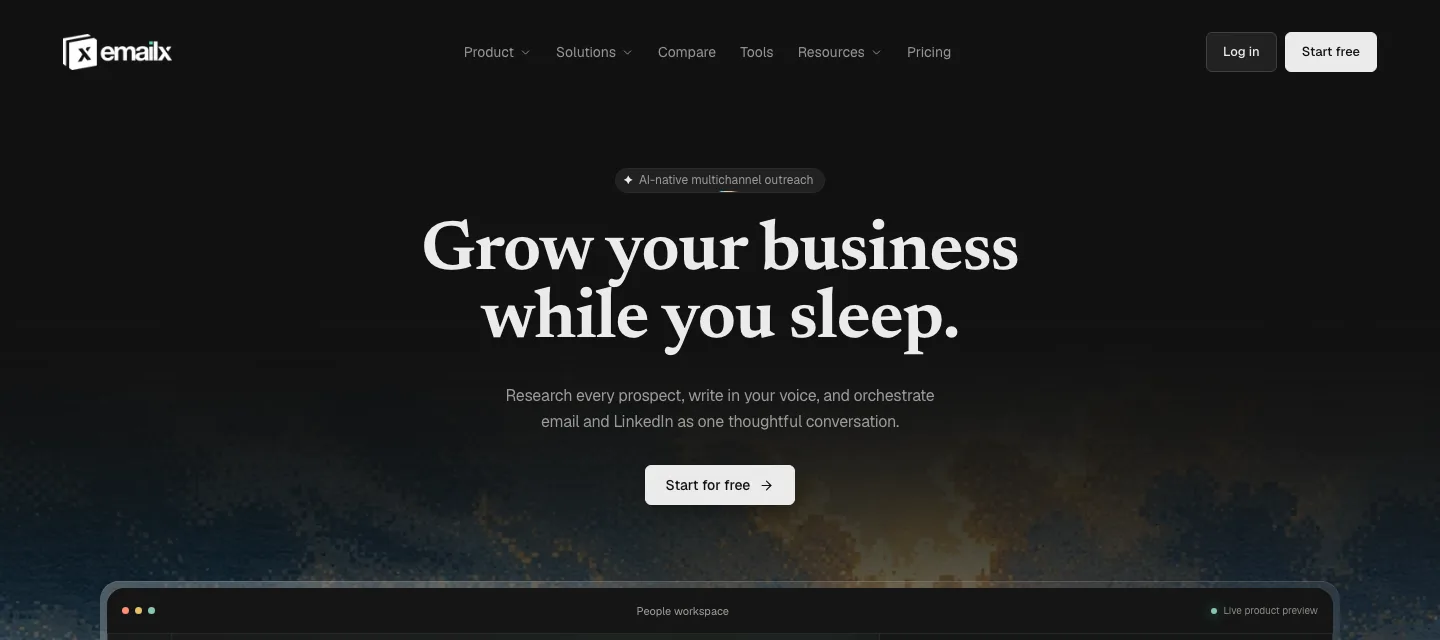
Emailx is built around a research step that happens before a message is written, and a review step before it sends. It reads each contact's LinkedIn profile, recent posts, and visible company signals, drafts from a campaign context you set once, and keeps that research visible next to the draft so a reviewer is evaluating evidence and wording together, not approving a message blind.
The default posture is review-before-send: nothing goes out until a human approves it, and edits feed back into the next batch. Once a segment has proven itself, autopilot can take over for that segment specifically, so the review gate is a choice you make deliberately per segment rather than an all-or-nothing switch.
Email and LinkedIn run from the same campaign as equal channels, with the sequence stopping on the first reply from either. Pricing is public and on the site, not a number you learn on a sales call.
Best features
- Research stays visible next to every draft, not hidden behind the send
- Review and approve before sending by default; autopilot per trusted segment
- Email and LinkedIn as equal channels in one campaign
- Public pricing, no sales call required to see a number
- Domains, mailboxes, and warm-up bundled in plan
Pricing
- 7-day trial, card required (up to 250 emails included)
- Plans scale with sending volume, not seats: email from $29/month annual, email + LinkedIn from $83/month annual
- Enterprise: custom, book a consultation
Artisan
Overview
 Product overview
Artisan sells Ava, an AI BDR positioned as full headcount replacement rather than a tool a rep operates: she sources leads from a 250M+ contact database, enriches and prioritizes them with intent signals, writes and sends outreach from the rep's own name and domain, handles replies and objections, and books meetings. A native AI dialer add-on covers the phone channel. The platform is genuinely broad (sequencing, enrichment, CRM sync, and dialing in one system rather than stitched-together point tools) and it holds solid review scores: 4.1/5 on G2 across 52 reviews, 4.2/5 ("Great") on Trustpilot across 41.
The default mode is autonomous: Ava sends without a human approving each message unless the customer specifically configures approval gates, locks tone and CTAs, or sets banned phrases. That configurability is real, Artisan is not incapable of review, but it is opt-in against an autonomous default, which is the inverse of Emailx's posture.
Pricing is entirely sales-gated. Nothing on artisan.co states a number; every tier is 'talk to sales,' scoped to lead volume, mailboxes, and dialer seats. Every review source checked, including Trustpilot reviews themselves, flags this as a source of friction: the real cost surfaces only after a sales conversation.
Best features
- Full-platform autonomous outbound: sourcing, writing, sending, replies, booking
- Native AI dialer add-on for the phone channel
- Autonomous sending by default; approval gates and guardrails are opt-in
- Salesforce and HubSpot bi-directional sync, SOC 2 Type II, SSO/SAML
- Sales-gated pricing, scoped to volume and seats on a call
Pricing
- No public pricing anywhere on artisan.co
- Team, Scale, and Enterprise tiers, all 'talk to sales'
- Scoped to leads contacted/mo, mailboxes, and dialer seats
- Verify current tiers and what's included on a live sales call before committing
What sends teams looking for an Artisan alternative
The recurring themes in public reviews of Artisan, before any Emailx comparison.
Autonomous sending at volume without a visible quality gate
Ava's default mode drafts and sends without a human reviewing each message first. One Trustpilot reviewer who ran Artisan for several months put a number on the result: "we saw only about a 0.07% positive response rate, and almost none of the responses turned into meaningful interest... it did not deliver the outcome we were looking for" (Yad Senapathy, Apr 22, 2026). That is not a complaint about volume; sending more of something that isn't working just produces more of nothing.
The pattern shows up across other review sources too: copy that reads as competently written but generic, because nothing forces a human to look at what actually went out before it reached hundreds of inboxes. Autonomy is the entire pitch, but it removes the one checkpoint that would catch a message that technically sends fine and still doesn't work.
No price on the site, only a sales call
artisan.co states no number anywhere: every tier is 'talk to sales,' and pricing is scoped to lead volume, mailboxes, and dialer seats on a call. That is a deliberate sales-led model, and for an enterprise buyer used to custom quotes it may be unremarkable. For a team trying to evaluate options before investing a sales cycle, it means the actual cost is unknown until after the demo, which is exactly the friction independent reviews of Artisan describe as a recurring complaint.
The practical effect is that comparing Artisan to a transparently priced tool takes an extra step every other option on the list doesn't require. That is not evidence the pricing is bad; it is evidence that seeing it costs a sales call, which not every evaluator wants to spend.
Results vary sharply, and the product page won't tell you which you'll get
The Trustpilot rating distribution is the clearest evidence of this: 83% five-star and 10% one-star, almost nothing in between. Reviewers who got a fit that matched their motion (enough volume, a use case suited to broad autonomous outreach) describe real results. One reviewer put it plainly: it "helped us drop other tools we were using and use just one - it made the costs lower and efficiency higher" (Tomasz Bachosz, May 1, 2026). Reviewers whose fit was narrower or whose ICP needed more judgment per message describe the 0.07%-reply-rate outcome instead.
A bimodal rating distribution like this one is itself useful evidence: it says the product genuinely works well for a specific shape of use case, and genuinely doesn't for another, more than it says anything about average quality. The question worth asking before buying is which side of that split your outbound motion actually falls on.
Should your team switch?
Start with the work that is difficult today, not the longest feature list.
Switch to Emailx if…
You want research visible next to every draft, not a message you approve without knowing what produced it.
You want review-before-send as the default, with autopilot available once a specific segment has proven itself.
You want to see a real price today, not after a sales call scoped to your volume.
The 0.07%-reply-rate failure mode reviewers describe, generic-sounding copy sent at volume with no gate, is exactly the outcome you're trying to avoid.
Stay with Artisan if…
You want to replace BDR headcount outright, not equip a smaller team, and full autonomy by default is the point, not a risk.
You want one platform covering sourcing, sequencing, dialing, and CRM sync rather than a research-and-drafting tool.
You have the sales cycle to spend finding out the real price, and enterprise-grade rollout support (a named CSM, SOC 2 Type II, SSO/SAML) matters more than seeing a number today.
What changes when you move from Artisan to Emailx
The decision becomes clearer when you follow the work from research to reply.
Review before sending, or autonomous by default
This is the actual decision, not a side detail: does the product default to a human looking at each message before it reaches a prospect, or does it default to sending and let you opt into guardrails? Both are legitimate design choices, and both products support some version of the other's mode, but the default is what most customers actually run.
Emailx defaults to review-before-send, with research visible alongside the draft and autopilot available once you've deliberately trusted a segment. Artisan defaults to autonomous: Ava sends without approval unless you configure gates, tone locks, and banned phrases yourself. For a team whose past failure mode looked like the 0.07%-reply-rate review above, defaulting to review rather than opting into it after the fact is the structural fix, not a workaround.
A number on the page, or a number on a call
Evaluating tools takes time regardless of price, and whether that number is visible up front changes how much time a comparison costs. A published price lets a buyer rule products in or out before investing in a demo; a sales-gated price means the investment happens first.
Emailx publishes its pricing on the site. Artisan states no number anywhere on artisan.co: every tier requires a sales conversation, scoped to lead volume, mailboxes, and dialer seats. That is a deliberate enterprise sales model and it isn't inherently worse, but reviewers checked for this page consistently name it as friction, and it's a real cost to factor into how much a comparison is worth doing.
One broad platform, or a focused research-and-drafting tool
Artisan's real strength is breadth: lead sourcing from a 250M+ contact database, enrichment, sequencing, reply handling, meeting booking, and a native AI dialer, plus bi-directional Salesforce and HubSpot sync, in one system. For a team trying to replace an entire BDR function with one platform, that consolidation is a genuine reason to choose it.
Emailx is narrower by design: it researches and drafts email and LinkedIn outreach with a human review step, rather than running the full sourcing-through-dialing motion. For a team that already has a lead source and a CRM and wants the writing and review layer to be excellent rather than the whole stack to be autonomous, that focus is the fit; for a team that wants one system replacing the entire function, Artisan's breadth is the stronger case.
When switching is not the right move
A good comparison should make the reasons not to switch just as visible.
When Emailx is not the right switch
- You want to replace BDR headcount outright with one autonomous system, not equip a smaller team with a review-first tool.
- You need the phone channel and CRM-triggered campaigns (MQL re-engagement, closed-lost win-back) natively in the same platform.
- Enterprise rollout support (a named CSM, SOC 2 Type II, SSO/SAML, audit logs) matters more to you than seeing a price today.
When an Emailx trial is worth running
- You've seen the AI-slop-at-volume outcome reviewers describe and want research visible next to every draft instead.
- You want review-before-send as the default, not a guardrail you have to configure against an autonomous default.
- You want to see a real price before spending a sales cycle finding out what it costs.
Should you switch from Artisan?
Artisan is the right tool for a team that wants to replace BDR headcount outright with one autonomous, full-platform system, and is comfortable with a sales-gated price to get there. It holds solid aggregate ratings (4.1 on G2, 4.2 on Trustpilot) and real enterprise-grade rollout support. It is not a poor product. But its own review base shows a sharply bimodal split, and the reviewers on the wrong side of it describe exactly the failure mode you'd expect from autonomous sending without a visible quality gate: technically-sent copy that reads as generic and gets close to zero replies. Emailx is built for the other side of that trade: research stays visible next to every draft, review-before-send is the default rather than an opt-in guardrail, and pricing is on the site rather than behind a sales call. Try Emailx on one campaign where message fit matters more than raw autonomy, and compare what you can actually see about the cost and the process before you commit either way.
Sources
Verified September 7, 2026. Competitor capabilities and prices change, so each source below records the date it was checked.
- Artisan pricing and FAQChecked September 7, 2026
- Artisan reviews on G2Checked September 7, 2026
- Artisan reviews on TrustpilotChecked September 7, 2026